
Banana PDRN is a PDRN (polydeoxyribonucleotide) ingredient marketed as plant-derived, which skincare brands use as an alternative to salmon PDRN; some brands call it “BDRN.” On an ingredient list it usually appears as Sodium DNA together with a banana (Musa Sapientum) water or extract, so the label alone doesn’t show where the DNA came from. Moe’s Group LLC formulates, fills and labels private label banana PDRN serums, essences, ampoules, creams and sheet masks at its FDA-registered facility in Chatsworth, California, from 1,000 units for a custom formula. Our ISO 22716, ISO 9001 and ISO 45001 certificates are on the certifications page.
Last updated: October 2026
| Banana PDRN manufacturing at a glance | Detail |
|---|---|
| Manufacturer | Moe’s Group LLC |
| Facility | 9743 Independence Ave, Chatsworth, CA 91311 (Los Angeles) |
| Ingredient | Banana PDRN, also called BDRN: sodium DNA paired with banana water or extract |
| Formats | Serum, essence, ampoule, cream, sheet mask |
| Service models | Private label, custom formulation |
| Minimum order | 1,000 units for a custom formula |
| Raw material documents | Supplier spec sheet and certificate of analysis provided with your quote |
| Formulation | In house, by our own chemists |
| Filling and labelling | In house, in Chatsworth |
| Quality | FDA-registered facility; ISO 22716 cosmetics GMP, ISO 9001, ISO 45001 |
| Contact | +1 (866) 777-6751 or the Request for Quote form |
What is banana PDRN?
Banana PDRN is a cosmetic ingredient that pairs sodium DNA (PDRN) with banana water or extract, marketed as a plant-based alternative to salmon PDRN. Plant versions such as rose and banana PDRN followed salmon PDRN for brands that want an animal-free story. In a finished cosmetic, banana PDRN is used as a hydrating, skin-conditioning ingredient in serums, essences, creams and other leave-on products.
What is BDRN?
BDRN is a marketing name some skincare brands use for banana-derived PDRN; it is not an INCI name, so it won’t appear on an ingredient list. Shoppers and buyers search for BDRN as an alternate name for banana PDRN, and in practice the two terms describe the same kind of ingredient: sodium DNA marketed as coming from banana. Because neither term has a standard definition, a product called BDRN tells you no more about its source than one called banana PDRN. The supplier’s spec sheet does.
How does banana PDRN appear on an ingredient list?
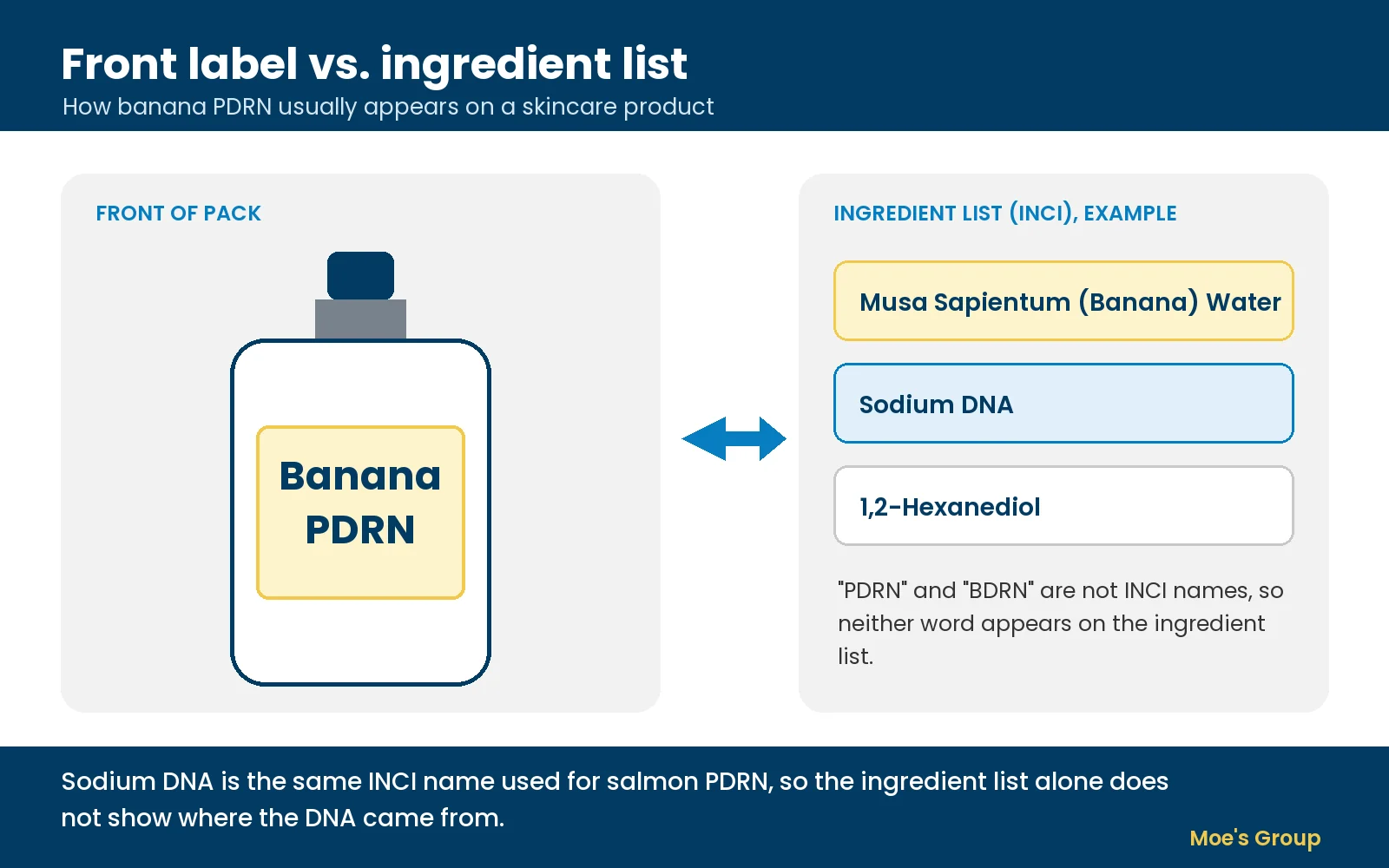
Usually as Musa Sapientum (Banana) Water or Fruit Extract plus Sodium DNA, often with 1,2-Hexanediol; one published supplier listing gives it as “Musa Sapientum (Banana) Water, Sodium DNA, 1,2-Hexanediol.” Sodium DNA is the same INCI name used for salmon PDRN, so the ingredient list alone does not show where the DNA came from. The exact INCI for a Moe’s Group formula comes from the raw-material spec sheet, which we share with your quote, and should be confirmed before your label artwork goes to print.
Is banana PDRN vegan?
Only if the supplier documents that the sodium DNA itself is plant-derived; “Sodium DNA” is the same INCI name whether the DNA comes from salmon or a plant, so the ingredient list can’t prove it. Suppliers describe extracting DNA from plant material and purifying it into short fragments, and methods differ by supplier. A formula should be called vegan only when the supplier’s written source statement and a check of every other ingredient support it. US law has no legal definition of “vegan” for cosmetics, so the claim falls under the FTC’s rule that marketing claims must be truthful and substantiated.
How does banana PDRN compare with salmon and rose PDRN?
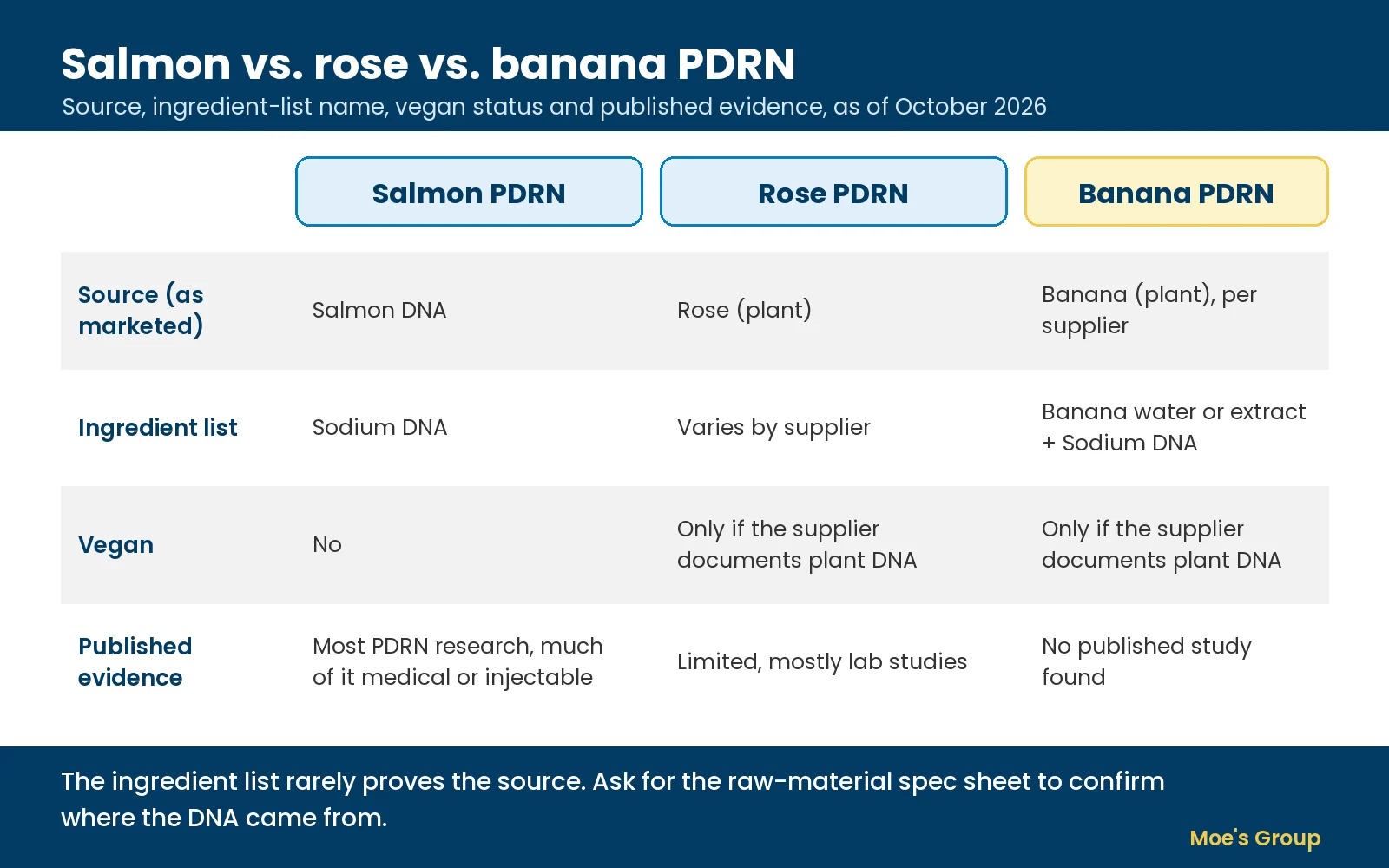
The main differences are the marketed source, vegan status and the amount of published research. Salmon PDRN has by far the most research behind it, rose PDRN has a little, and banana PDRN has none published as of October 2026. For the salmon and rose detail, see our salmon PDRN vs rose PDRN comparison.
| Salmon PDRN | Rose PDRN | Banana PDRN | |
|---|---|---|---|
| Source (as marketed) | Salmon DNA | Rose (plant) | Banana (plant), per supplier |
| How the ingredient list reads | Sodium DNA | Varies by supplier | Banana water or extract + Sodium DNA |
| Vegan | No | Only if the supplier documents plant DNA | Only if the supplier documents plant DNA |
| Published evidence | Most PDRN research, much of it medical or injectable | Limited, mostly lab studies | No published study found as of October 2026 |
| Common formats | Serum, ampoule, cream, mask | Serum, essence, cream | Serum, cream, eye-area products |
| At Moe’s Group | In stock | In stock | Quoted per project, with spec sheet and certificate of analysis |
What does the research say about banana PDRN?
There is no published study on banana-derived PDRN: a PubMed search on October 23, 2026 returned no results. Most PDRN research uses salmon-derived PDRN, much of it in medical and injectable settings that don’t apply to a cosmetic. Plant PDRN research is mostly laboratory work. One small 2025 study in the International Journal of Molecular Sciences tested a cream with 1% low-molecular-weight peony-derived PDRN on 10 people for 4 weeks and reported modest improvements in skin-elasticity and moisture-barrier readings against a control cream; its authors note the small sample and short duration. A July 2026 review in the Journal of Functional Biomaterials concluded that plant-derived PDRN should not yet be considered clinically or mechanistically equivalent to animal-derived PDRN.
Peony and salmon results are not evidence for banana, and a banana PDRN product should not borrow them.
What can a banana PDRN product claim?
Cosmetic claims about how skin looks and feels are allowed with substantiation; claims that the product changes skin structure or treats a condition make it a drug under US law. That line comes from FDA’s guidance “Is It a Cosmetic, a Drug, or Both? (Or Is It Soap?)”, and the FTC expects every claim to be backed by competent evidence. Settle your claims before label artwork, and base them on testing of your finished product, not on the raw material’s reputation.
| Can say (with substantiation on the finished product) | Cannot say (drug claim or unsupported) |
|---|---|
| Hydrates skin; skin looks smoother and more even | Repairs, regenerates or heals skin; “DNA repair” |
| Softens the look of fine lines; plumper-looking skin | Boosts or stimulates collagen; cell renewal or regeneration |
| Brightens the look of tired-looking under-eyes | Removes or prevents dark circles; anti-inflammatory |
| “Made with banana PDRN” (if it is in the formula) | Treats acne, rosacea, scars or eczema |
| “Plant-derived PDRN” (if the spec sheet says so) | “Injection results without needles”; “same as salmon PDRN” |
| “Vegan” (if every ingredient is verified) | Approved by the FDA; “clinically proven” (unless the finished product was tested for exactly that claim) |
Which banana PDRN formats can Moe’s Group make?
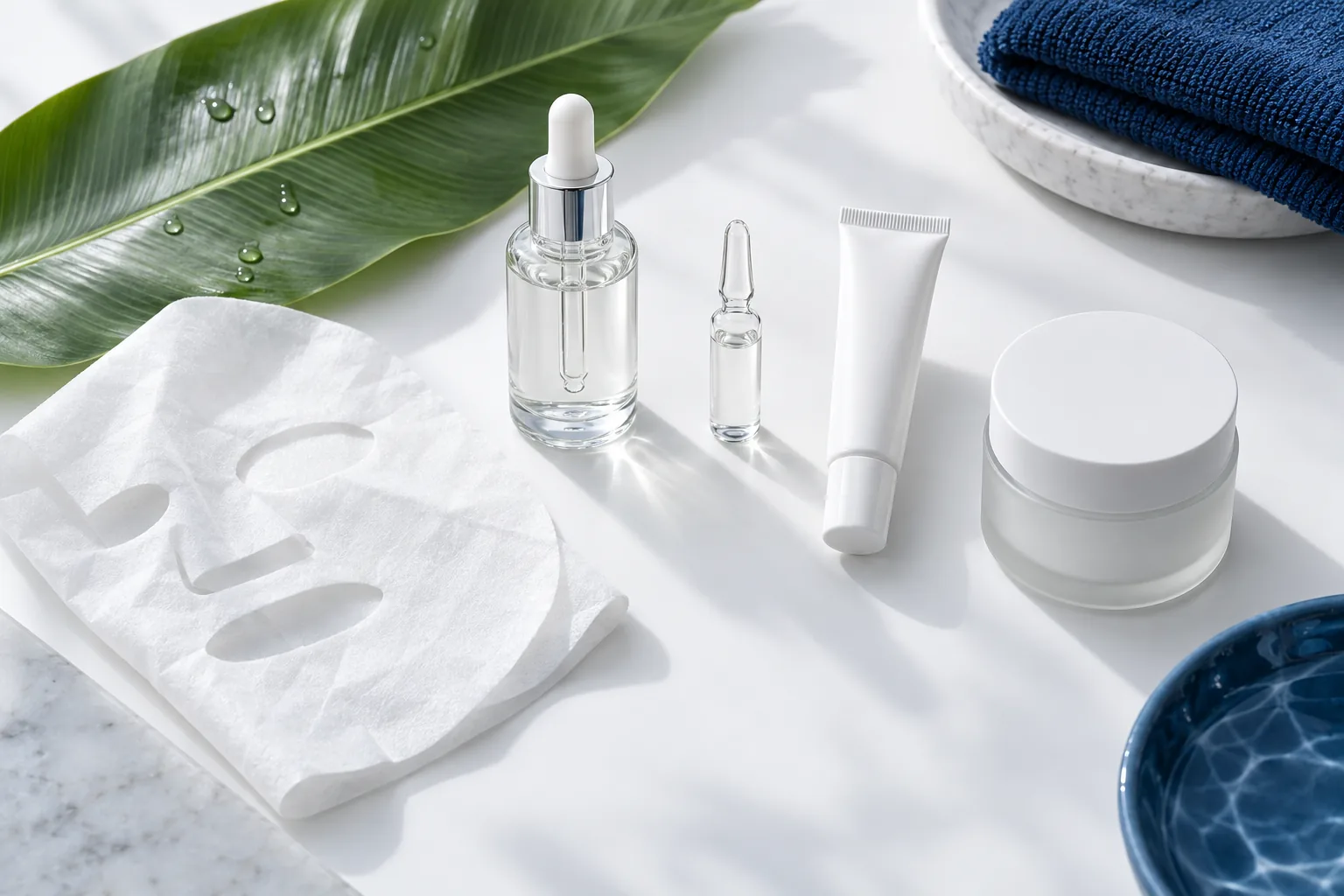
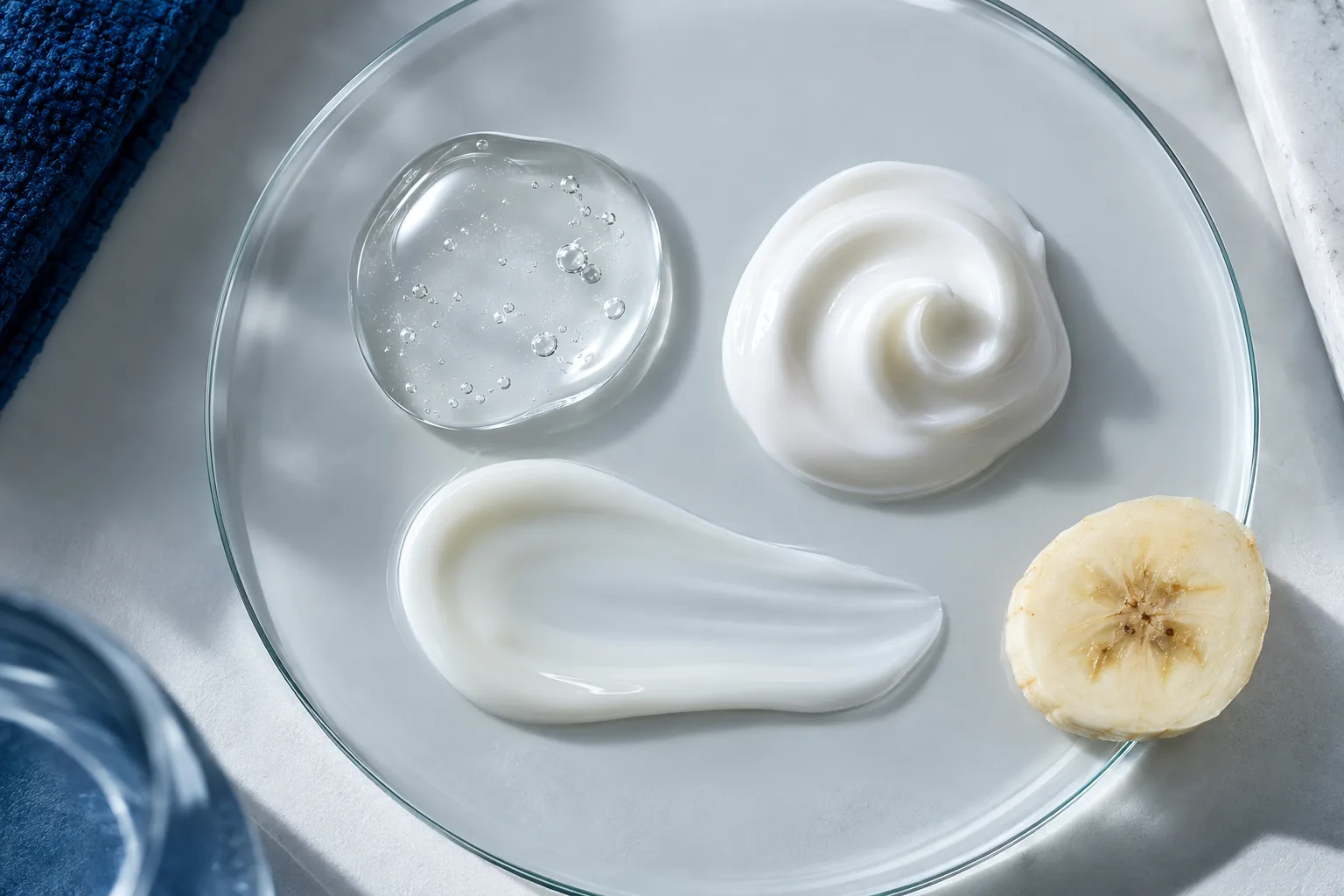
We make banana PDRN products in the formats our PDRN line already covers: serum, essence, ampoule, cream and sheet mask. Eye care is where most banana PDRN demand sits; US searches for “banana PDRN eye cream” averaged about 1,400 a month over the three months to October 2026. If you want an eye-area product, say so in your brief and our chemists will confirm the format and packaging with your quote.
How does a banana PDRN project work at Moe’s Group?
It runs in five steps, from brief to filled and labelled product, all at our facility in Chatsworth, California.
- Send your brief. Tell us the format, the positioning, the claims you hope to make and the volume, through the Request for Quote form.
- Review the raw-material documents. With your quote we provide the banana PDRN supplier’s spec sheet and certificate of analysis, so you can confirm the INCI name and the DNA source statement before you commit.
- Formulation. Our in-house chemists develop the formula to your specification, and you approve it before production.
- Settle the claims. Keep your label claims cosmetic, using the table above, and substantiate them on the finished product.
- Production. Filling and labelling run in house in Chatsworth, from 1,000 units for a custom formula.

Can Moe’s Group make banana PDRN products, and what is the MOQ?
Yes: Moe’s Group formulates, fills and labels private label banana PDRN skincare in Chatsworth, California, from 1,000 units for a custom formula. We formulate to your specification with a banana PDRN raw material marketed as plant-derived, and the supplier’s spec sheet and certificate of analysis come with your quote. Lead time depends on the formula and is set out in your quote. Salmon PDRN and rose PDRN are also held in stock if you want to compare sources, and the facility is FDA-registered and certified to ISO 22716 for cosmetics GMP, with ISO 9001 and ISO 45001. See our PDRN manufacturing page for the full PDRN range.
Frequently asked questions
What is banana PDRN?
A PDRN (sodium DNA) ingredient paired with banana water or extract and marketed as plant-based. It’s used in serums, creams and other leave-on skincare as a hydrating, skin-conditioning ingredient.
What does banana PDRN do?
In a cosmetic, banana PDRN is used to hydrate and condition skin and help it look smoother and more even. Claims beyond appearance, such as repairing or regenerating skin, would make the product a drug under US law.
Does banana PDRN work?
As of October 2026 a PubMed search found no published study on banana-derived PDRN. Brands should base their claims on testing of their own finished product and keep those claims to appearance.
Is banana PDRN the same as BDRN?
Usually, yes. BDRN is a marketing name some brands use for banana-derived PDRN. It isn’t an INCI name, so the ingredient list will still say Sodium DNA.
Is vegan PDRN as effective as salmon PDRN?
Nobody has shown that it is. Direct comparisons on skin are limited, and a 2026 review concluded that plant-derived PDRN should not yet be considered clinically equivalent to salmon PDRN, so a vegan formula shouldn’t claim to match salmon PDRN results.
How can I tell if a product uses plant-based or salmon-based PDRN?
Not from the ingredient list alone, because both appear as Sodium DNA. Look for the brand’s source statement, or ask the manufacturer for the raw-material spec sheet.
Does a banana PDRN product have to be approved by the FDA?
No. Cosmetics and cosmetic ingredients, other than color additives, are not approved by the FDA before they go on sale; the brand is responsible for the product’s safety and for keeping its claims cosmetic. As of October 2026 we found no PDRN drug approved by the FDA in the US.
What is the minimum order for a private label banana PDRN serum?
1,000 units for a custom formula at Moe’s Group. Lead time depends on the formula and is set out in your quote.
Related pages
- PDRN manufacturing
- Salmon PDRN vs rose PDRN comparison
- Rose PDRN and salmon PDRN in stock
- Private label skincare manufacturing
- Peptide skincare contract manufacturing
- Blue copper peptide manufacturing
- Exosome skincare manufacturing
- Our California skincare manufacturing facility
- Certifications and FDA facility registration
Sources
- U.S. Food and Drug Administration, “Is It a Cosmetic, a Drug, or Both? (Or Is It Soap?)”
- U.S. Food and Drug Administration, “FDA Authority Over Cosmetics”
- Federal Trade Commission, “Health Products Compliance Guidance” (December 2022)
- “Anti-Aging Efficacy of Low-Molecular-Weight Polydeoxyribonucleotide Derived from Paeonia lactiflora,” International Journal of Molecular Sciences, 2025
- Kim, Lee, Kim and Son, “Plant-Derived Polynucleotides/Polydeoxyribonucleotides in Skin Biomaterials: Delivery Platforms and Bioactivity Attribution,” Journal of Functional Biomaterials 17, 351 (July 2026)
- PubMed search for banana AND (PDRN OR polydeoxyribonucleotide), October 23, 2026: 0 results
Start a banana PDRN product
Tell us the format, the volume and the claims you have in mind, and our chemists will come back with options, the banana PDRN spec sheet and a quote. Prefer to talk it through first? Book a free consultation.