

Private label hand cream, hand lotion, hand balm, cuticle oil, urea foot cream, heel balm and foot scrub are hand and foot care products made to a formula and sold under your brand; as cosmetics, their claims stay with how hands and feet look and feel. Moe’s Group LLC formulates, fills and labels them at its FDA-registered facility in Chatsworth, California: custom private label from 1,000 units; white label from 200 units where a ready formula exists. Our ISO 22716, ISO 9001 and ISO 45001 certificates are on the certifications page.
Last updated: October 2026
| Hand and foot care manufacturing at a glance | Detail |
|---|---|
| Manufacturer | Moe’s Group LLC |
| Facility | 9743 Independence Ave, Chatsworth, CA 91311 (Los Angeles) |
| Formats | Hand cream, hand lotion, hand balm, cuticle oil, urea foot cream, heel balm, foot scrub |
| Urea strength | Set in your brief and confirmed with your quote |
| Service models | Custom private label; white label where a ready formula exists |
| Minimum order | custom private label from 1,000 units; white label from 200 units where a ready formula exists |
| Claims | Cosmetic only: how hands and feet look and feel |
| Formulation | In house, by our own chemists |
| Filling and labelling | In house, in Chatsworth |
| Quality | FDA-registered facility; ISO 22716 cosmetics GMP, ISO 9001, ISO 45001 |
| Contact | +1 (866) 777-6751 or the Request for Quote form |
What are private label hand and foot care products?
They are creams, lotions, balms, oils and scrubs for hands, cuticles and feet, made by a manufacturer to a formula and sold under your brand name. Private label hand cream sells into a winter and gift-set season. Each one stays a cosmetic only while its claims are about how skin looks and feels.
Why is urea in so many foot care briefs?
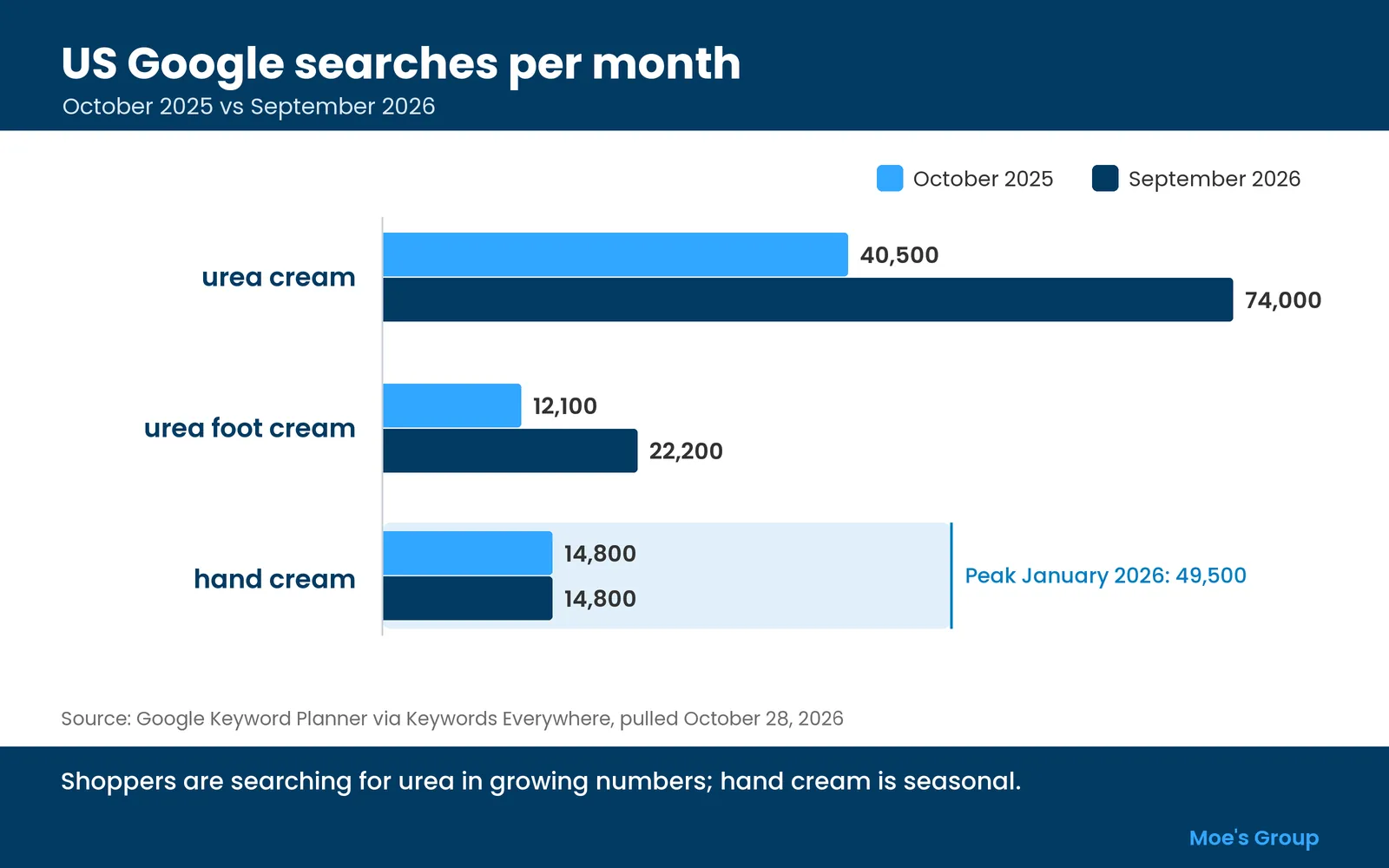
Because shoppers are searching for it in growing numbers. US Google searches for “urea cream” rose from 40,500 in October 2025 to 74,000 in September 2026, and “urea foot cream” from 12,100 to 22,200. On Amazon US, “urea cream” searches grew 60% year on year to 185,489 in September 2026, against 18% for the search “body lotion” over the same period (VOC.ai Amazon keyword data).
Hand cream is seasonal: Google searches peaked at 49,500 in January 2026 and were back to 14,800 by September, unchanged from October 2025. Cuticle oil is large but down 8% on Amazon.
What urea percentage should a hand or foot cream use?
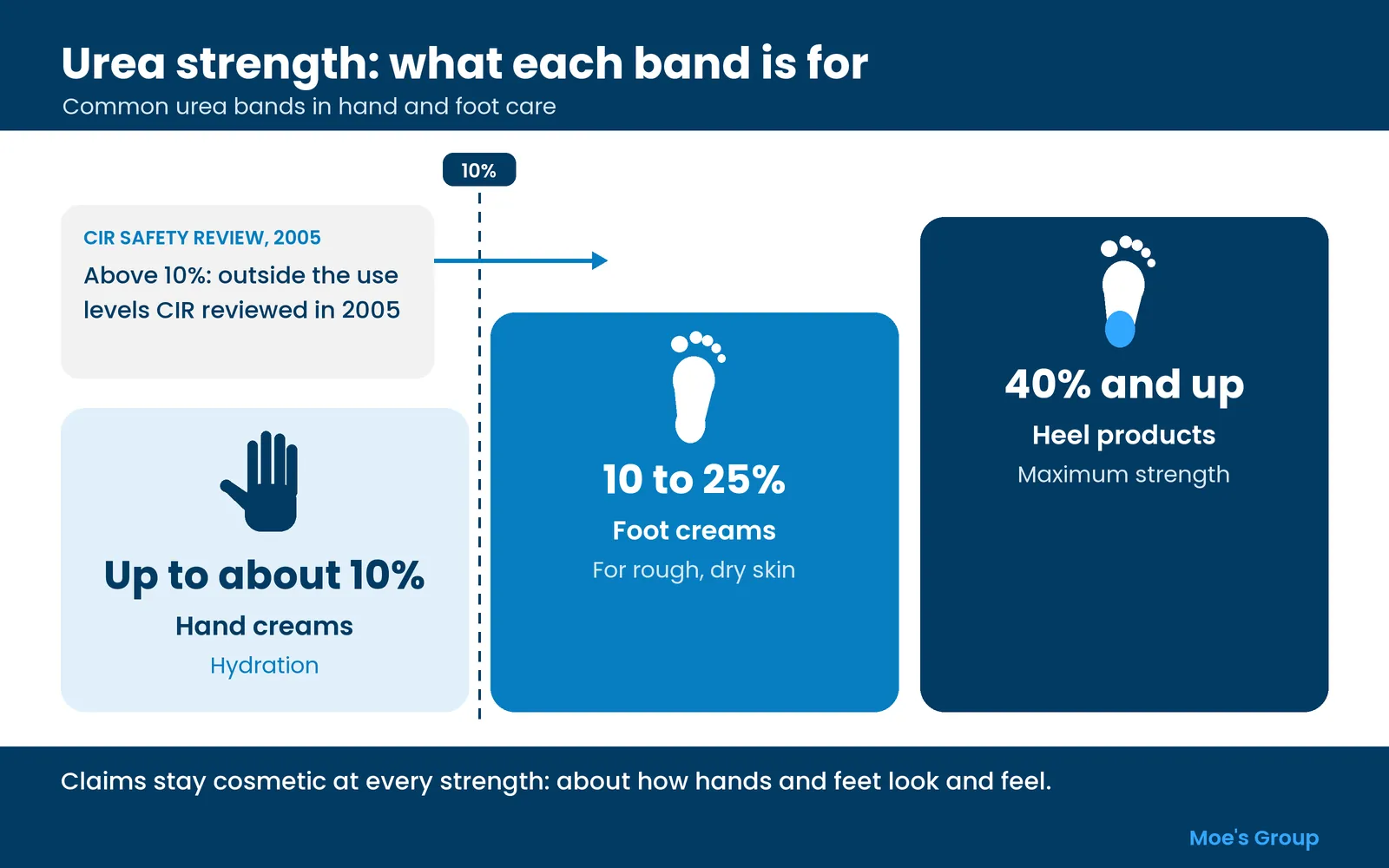
It depends on the job. Hand creams usually carry up to about 10% urea for hydration, foot creams for rough, dry skin 10 to 25%, and “maximum strength” heel products 40% or more.
Two facts matter at the top end. The Cosmetic Ingredient Review panel concluded in 2005 that urea is safe as used in cosmetics, but the use levels it reviewed ran from 0.01% to 10%. Under MoCRA every cosmetic needs adequate safety substantiation, and the brand is responsible for it; above 10%, the brand cannot lean on the CIR review for it. And 40% urea is also sold as a prescription drug: the FDA’s NDC directory lists 33 prescription urea products, 17 of them at 40% (openFDA, October 28, 2026). A 40% cream stays a cosmetic only while every claim on it is about appearance and feel.
What makes high-urea creams hard to make?
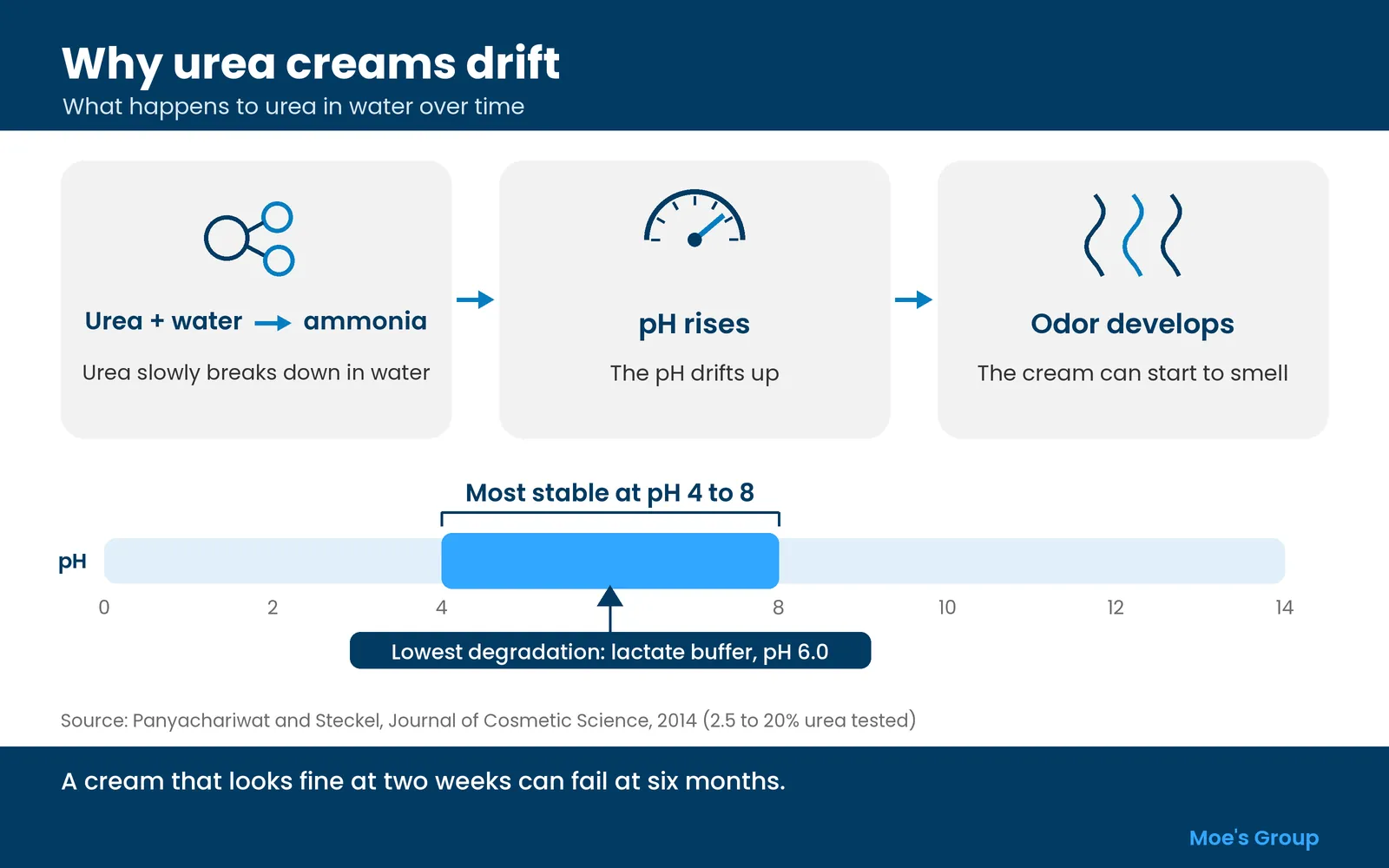
Urea slowly breaks down in water, releasing ammonia, so the pH drifts up and the cream can start to smell. A 2014 Journal of Cosmetic Science study of 2.5 to 20% urea found it most stable between pH 4 and 8, degrading faster as temperature rises, with the lowest rate in a lactate buffer at pH 6.0. A cream that looks fine at two weeks can fail at six months.
The CIR report also notes that urea increases skin absorption of other ingredients, which matters if you add acids or strong fragrance.
What a high-urea brief needs: a buffered formula with its pH set around the urea, urea added after the heated stage, and stability testing that tracks pH and odor, not only appearance, in the final pack. Our chemists will confirm with your quote how they would formulate and test yours.
How do hand creams, hand balms and foot creams compare?
By base, finish and the job they do. A hand cream has to absorb faster than a body lotion and hold up to hand washing, so it usually carries more humectant, a light occlusive and a drier finish. For whole-body formats, see private label body lotion manufacturing.
| Format | Base | Ingredients brands ask for | Common pack in the market |
|---|---|---|---|
| Hand cream | Cream emulsion | Glycerin, shea butter, ceramides, niacinamide, low-level urea | Squeeze tube or jar |
| Hand lotion | Light emulsion | Glycerin, aloe, hyaluronic acid | Pump bottle |
| Hand balm | Anhydrous (no water) | Shea or cocoa butter, plant waxes, beef tallow, plant oils | Tin or jar |
| Cuticle oil | Oil blend | Jojoba, sweet almond oil, vitamin E (tocopherol) | Dropper or brush-cap bottle |
| Urea foot cream | Cream emulsion | Urea, lactic acid, glycerin, shea butter | Squeeze tube or jar |
| Heel balm | Rich cream or anhydrous balm | Urea (cream versions), shea, cocoa butter, waxes | Jar |
| Foot scrub | Scrub in oil or butter | Sugar, salt or pumice, plant oils | Jar |
What can a hand or foot care product claim?
Claims about how hands and feet look and feel are cosmetic; claims that the product heals, treats a condition or changes how skin functions make it a drug under US law. Under MoCRA the brand is the responsible person for safety substantiation, product listing and the adverse-event contact on the label; see who files with the FDA.
| Can say (with substantiation on the finished product) | Cannot say (drug claim or unsupported) |
|---|---|
| Softens rough, dry skin on heels and elbows | Heals cracked heels; repairs damaged skin |
| Hands look less dry and feel smoother | “Temporarily protects and helps relieve chapped or cracked skin” (the OTC skin protectant claim) |
| Exfoliates for smoother-looking feet | Removes corns or calluses |
| Cuticles look neater and feel softer | Anything about athlete’s foot, fungus or nail fungus |
| “Made with 25% urea” (if the formula contains it) | Relief for eczema, psoriasis or diabetic skin |
| “Fragrance-free” (if no fragrance ingredient is used) | “Kills 99.9% of germs”; approved by the FDA; clinical claims without a study on your product |
Lactic acid is an alpha hydroxy acid, so FDA’s 2005 guidance also recommends a sunburn alert on lactic-acid foot creams.
When does a hand or foot product become an OTC drug?
When it makes a drug claim. If the claim, active ingredient and strength all fit an OTC drug monograph, it can be sold without premarket approval, but it needs a Drug Facts label and drug manufacturing standards; a drug claim no monograph covers needs an approved new drug application. Four claims come up often in this category.
- Chapped or cracked skin. “Temporarily protects and helps relieve chapped or cracked skin” is the skin protectant claim in OTC monograph M016 (formerly 21 CFR part 347). Its actives, such as dimethicone, glycerin or petrolatum, are fine in a cosmetic without the claim.
- Corns and calluses. Removers are drugs; the monograph allows salicylic acid at 12 to 40% in a plaster or 12 to 17.6% in a collodion-like liquid (21 CFR 358.510).
- Fungus claims are drug claims. Athlete’s foot is a drug claim under the topical antifungal monograph, OTC monograph M005 (formerly 21 CFR part 333, subpart C). No OTC monograph covers nail fungus, so a nail-fungus claim needs an approved new drug application.
- Germ-killing hand wash and sanitizer. Antiseptic drugs; FDA’s 2016 final rule removed triclosan and 18 other actives from consumer antiseptic washes. A hand wash that only cleans is a cosmetic, or, if it is true soap (mostly alkali salts of fatty acids, sold only for cleansing), a consumer product regulated by the CPSC.
If your brief needs a drug claim, say so before formulation starts and we will tell you with your quote whether we can take it on.
Which hand and foot care formats can Moe’s Group make?
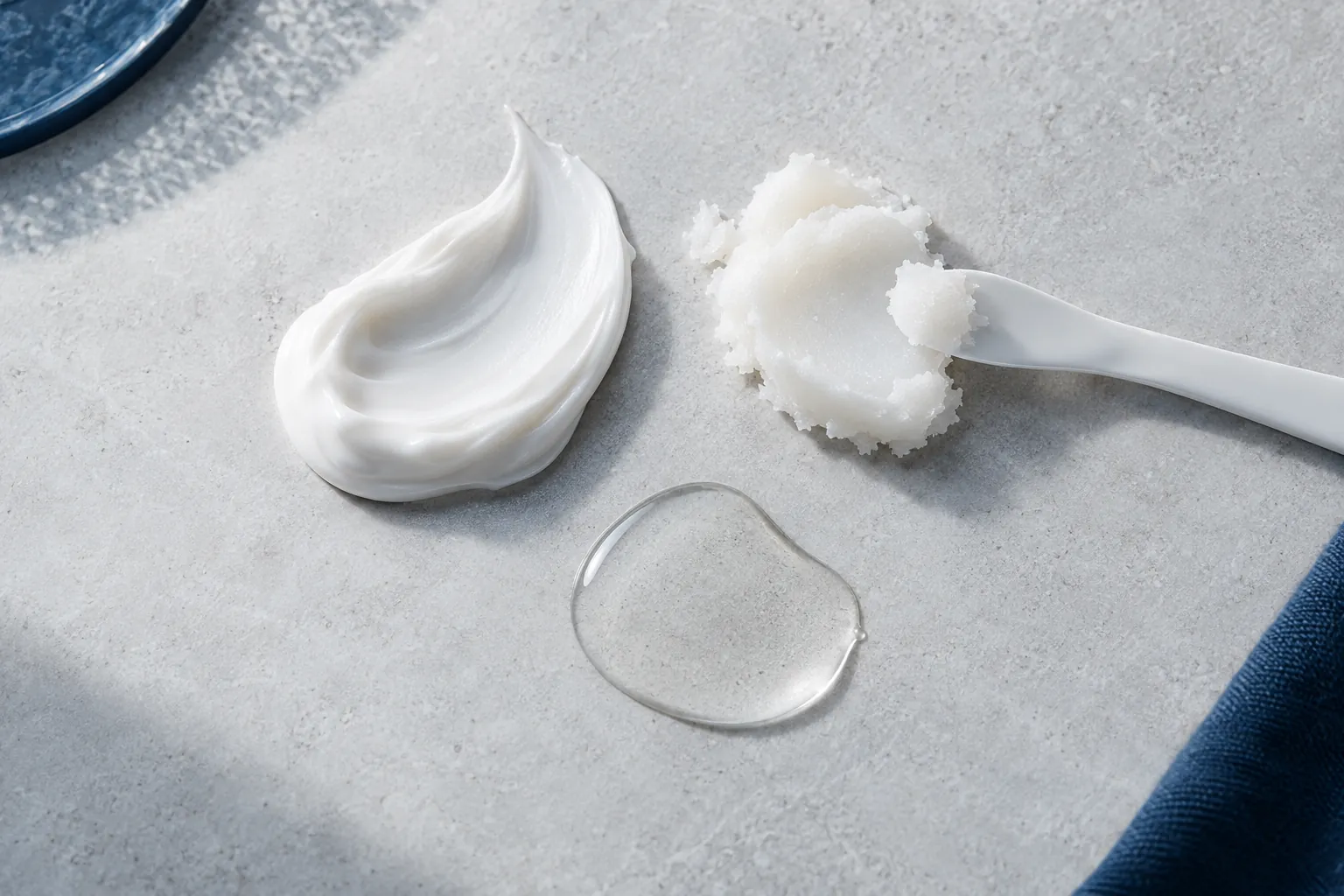
We make all seven formats in the table above, as creams, balms, oil blends or scrubs. The formats table lists the common market pack for each. Name the pack in your brief and we confirm with your quote whether we can fill it; see packaging for sourcing.
Beef tallow is a common ask for hand balms: “tallow hand cream” averaged 2,900 US Google searches a month (see tallow skincare manufacturing).
How does a hand and foot care project work at Moe’s Group?
It runs in five steps, from brief to filled and labelled product, all at our facility in Chatsworth, California.
- Send your brief. Formats, any urea strength, the claims you hope to make, the pack and the volume, through the Request for Quote form.
- Choose white label or custom. White label uses one of our existing formulas where one fits your format; custom private label is a formula developed for you. Custom private label from 1,000 units; white label from 200 units where a ready formula exists.
- Formulation. Our in-house chemists develop the formula to your specification, and you approve it before production.
- Settle the claims. Keep them cosmetic, using the table above, and substantiate them on the finished product.
- Production. Filling and labelling run in house in Chatsworth.

Can Moe’s Group make private label hand and foot care, and what is the MOQ?
Yes: Moe’s Group formulates, fills and labels private label hand cream, hand balms, cuticle oils, urea foot creams, heel balms and foot scrubs in Chatsworth, California, with custom private label from 1,000 units; white label from 200 units where a ready formula exists. The facility has capacity for up to 1,000,000 units a month across skin, hair and body care, is FDA-registered and is certified to ISO 22716 for cosmetics GMP, with ISO 9001 and ISO 45001. See our private label body care manufacturing page for the full body care range.
Frequently asked questions
Can you make a 40% urea foot cream?
Tell us the urea strength in your brief and our chemists will confirm with your quote whether and how we can make it. Above 10% you cannot rely on the 2005 CIR review, whose use levels ran up to 10%, and the cream’s claims must stay cosmetic.
Is urea cream a cosmetic or a drug?
It depends on the claims. A urea cream that softens rough, dry skin is a cosmetic, but the FDA’s NDC directory also lists 33 prescription urea products, about half at exactly 40% and most at 39 to 41%.
Can a foot cream say it heals cracked heels?
No. Healing is a drug claim, and ‘temporarily protects and helps relieve chapped or cracked skin’ is an OTC skin protectant claim. A cosmetic can say it softens and smooths rough, dry-looking heels.
What is the difference between a hand cream and a hand balm?
A hand cream is a water-and-oil emulsion that absorbs quickly. A hand balm is anhydrous, made of butters, waxes and oils, so it is richer and slower to absorb.
Can you make private label cuticle oil?
Yes. Cuticle oil is an oil blend. Tell us the pack, dropper or brush-cap bottle, and we confirm the fill with your quote.
Do foot creams with lactic acid, and AHA foot peels, need special labelling?
Not by regulation, but FDA’s 2005 guidance recommends a sunburn alert on cosmetics containing alpha hydroxy acids, such as lactic or glycolic acid, used on skin that may be exposed to the sun.
Can a hand cream be labelled hypoallergenic?
Only with testing behind it. FDA says there is no federal standard or definition for hypoallergenic, so substantiate it on your finished product.
What is the minimum order for private label hand cream?
At Moe’s Group the minimum order is custom private label from 1,000 units; white label from 200 units where a ready formula exists. Lead time depends on the formula and is set out in your quote.
Related pages
- Private label body care manufacturing
- Private label body serum and active body care manufacturing
- Private label body scrub and body polish manufacturing
- Private label bar soap manufacturing
- Private label body lotion manufacturing
- Tallow skincare manufacturing
- Private label body products: cosmetic or drug?
- Cosmetic packaging
- Our California skincare manufacturing facility
- Certifications and FDA facility registration
Sources
- FDA, “Is It a Cosmetic, a Drug, or Both? (Or Is It Soap?)”; FDA, “Hypoallergenic Cosmetics”; MoCRA (2022)
- FDA, “Guidance for Industry: Labeling for Cosmetics Containing Alpha Hydroxy Acids” (January 2005)
- OTC Monograph M016, Skin Protectant Drug Products (formerly 21 CFR part 347); OTC Monograph M005 (final order, December 2021; formerly 21 CFR part 333, subpart C); 21 CFR 358.510; FDA final rule on consumer antiseptic washes (September 2016)
- Cosmetic Ingredient Review, “Final report of the safety assessment of Urea,” International Journal of Toxicology 24, Suppl. 3 (2005)
- Panyachariwat N, Steckel H, “Stability of urea in solution and pharmaceutical preparations,” Journal of Cosmetic Science 65, no. 3 (2014): 187-195
- openFDA NDC directory (generic name urea), Keywords Everywhere (Google Keyword Planner) and VOC.ai Amazon US keyword data, pulled October 28, 2026
Start a hand and foot care product
Tell us the formats, the urea strength and the claims you have in mind, and our chemists will come back with options and a quote. Prefer to talk it through first? Book a free consultation.