

A private label body scrub is an exfoliating body product, usually sugar or salt in an oil or butter base, that a manufacturer formulates, fills and labels under your brand name; a body polish is the finer, creamier version that rinses off to a smooth finish. Moe’s Group LLC formulates, fills and labels private label body scrubs and body polishes at its FDA-registered facility in Chatsworth, California: custom private label from 1,000 units; white label from 200 units where a ready formula exists. Our ISO 22716, ISO 9001 and ISO 45001 certificates are on the certifications page.
Last updated: October 2026
| Body scrub manufacturing at a glance | Detail |
|---|---|
| Manufacturer | Moe’s Group LLC |
| Facility | 9743 Independence Ave, Chatsworth, CA 91311 (Los Angeles) |
| Formats | Sugar and salt scrubs; body polish; enzyme polish |
| Exfoliants | Sugar, salt, coffee, jojoba esters, bamboo powder, fruit enzymes. No plastic microbeads |
| Service models | Custom private label; white label where a ready formula exists |
| Minimum order | custom private label from 1,000 units; white label from 200 units where a ready formula exists |
| Formulation | In house, by our own chemists |
| Filling and labelling | In house, in Chatsworth |
| Packaging | Wide-mouth jars and tubs; squeeze tubes for fine-grit polishes |
| Quality | FDA-registered facility; ISO 22716 cosmetics GMP, ISO 9001, ISO 45001 |
| Contact | +1 (866) 777-6751 or the Request for Quote form |
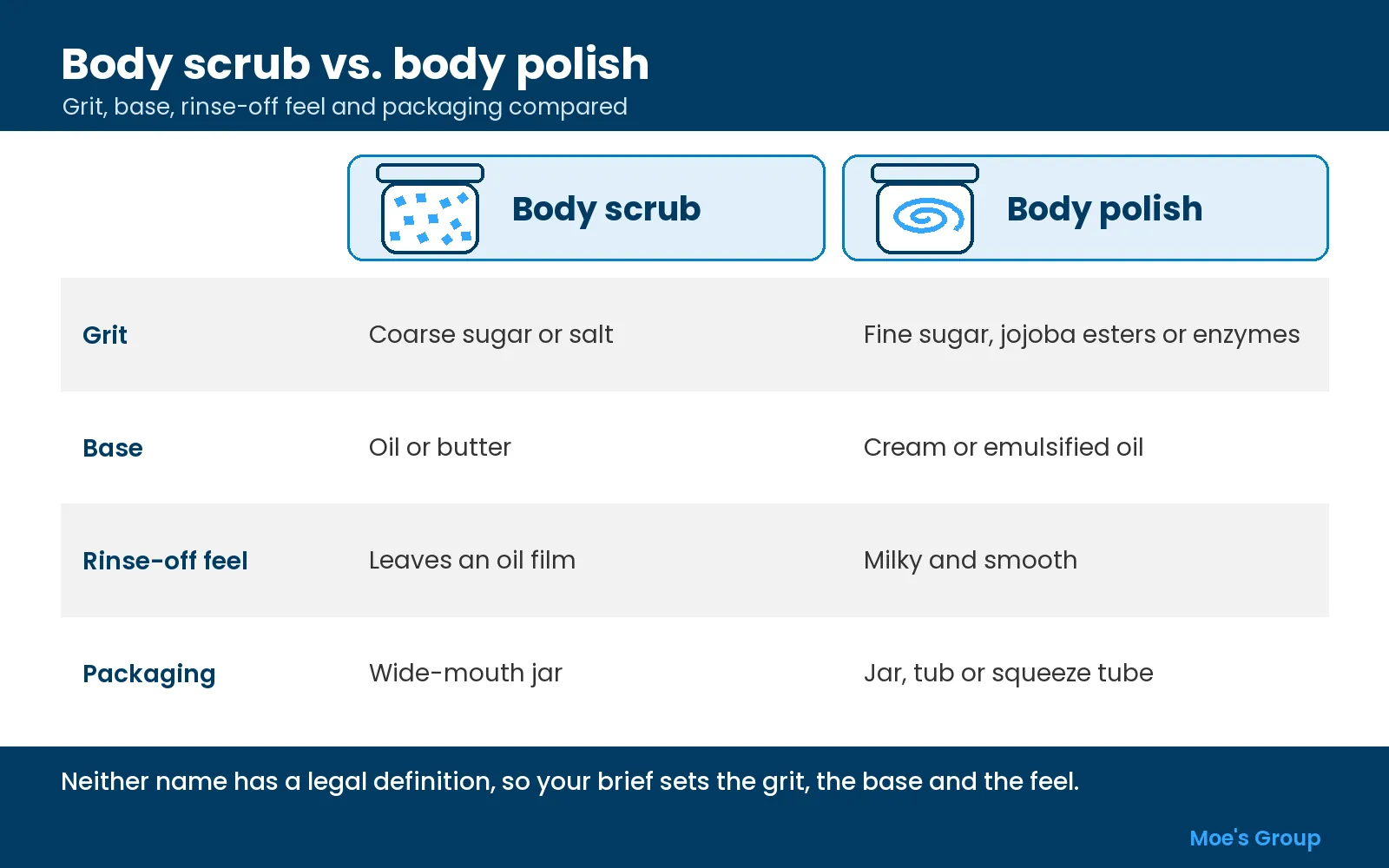
What is a body scrub, and how is a body polish different?
A body scrub is a rinse-off exfoliating product, usually coarse sugar or salt in an oil or butter base, that leaves an oil film on the skin; a body polish uses finer grit, such as fine sugar, jojoba esters or fruit enzymes, in a cream or emulsified oil base and rinses off milky and smooth. Neither name has a legal definition, so your brief sets the grit, the base and the feel.
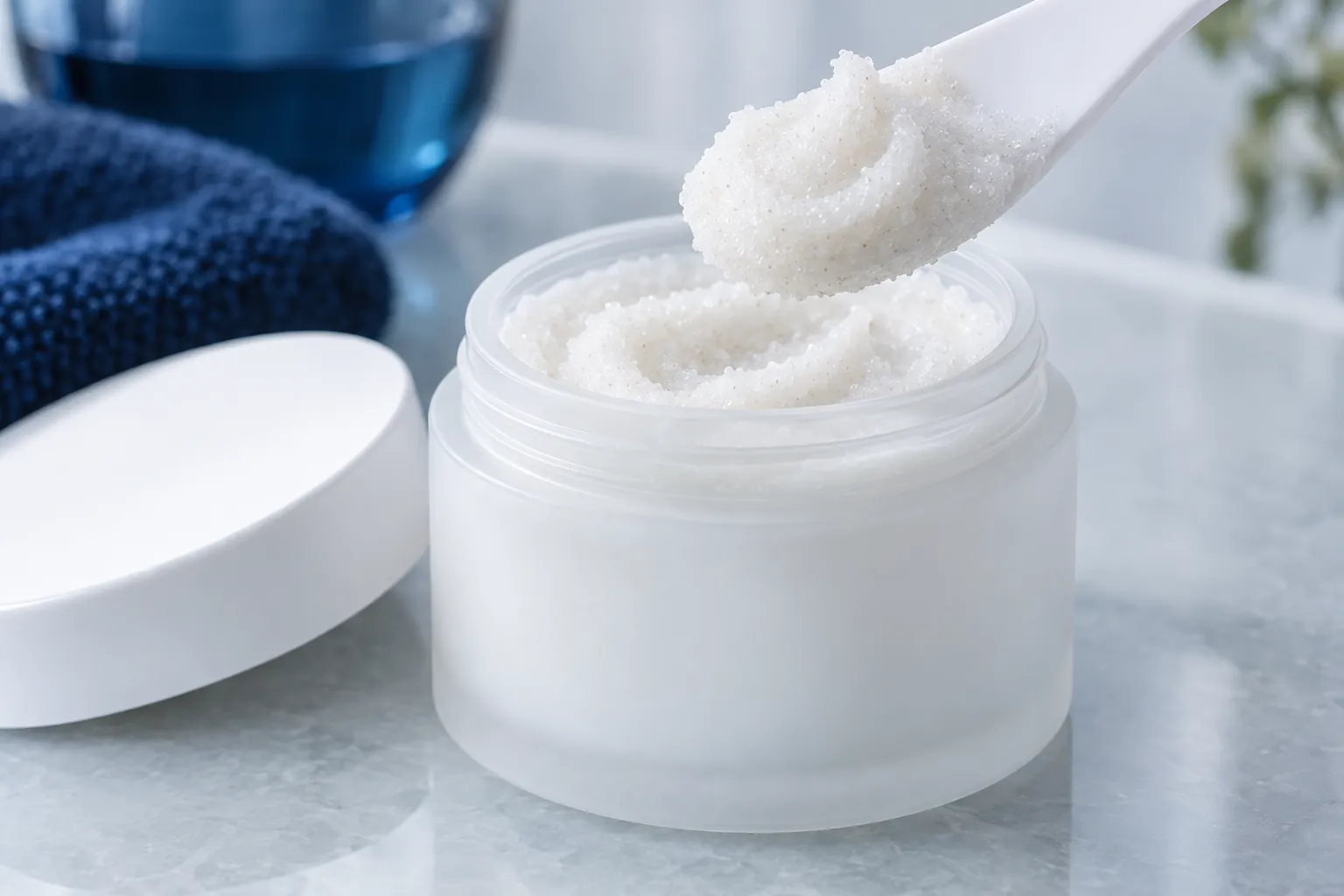
Which exfoliants work in a body scrub, and which are banned?
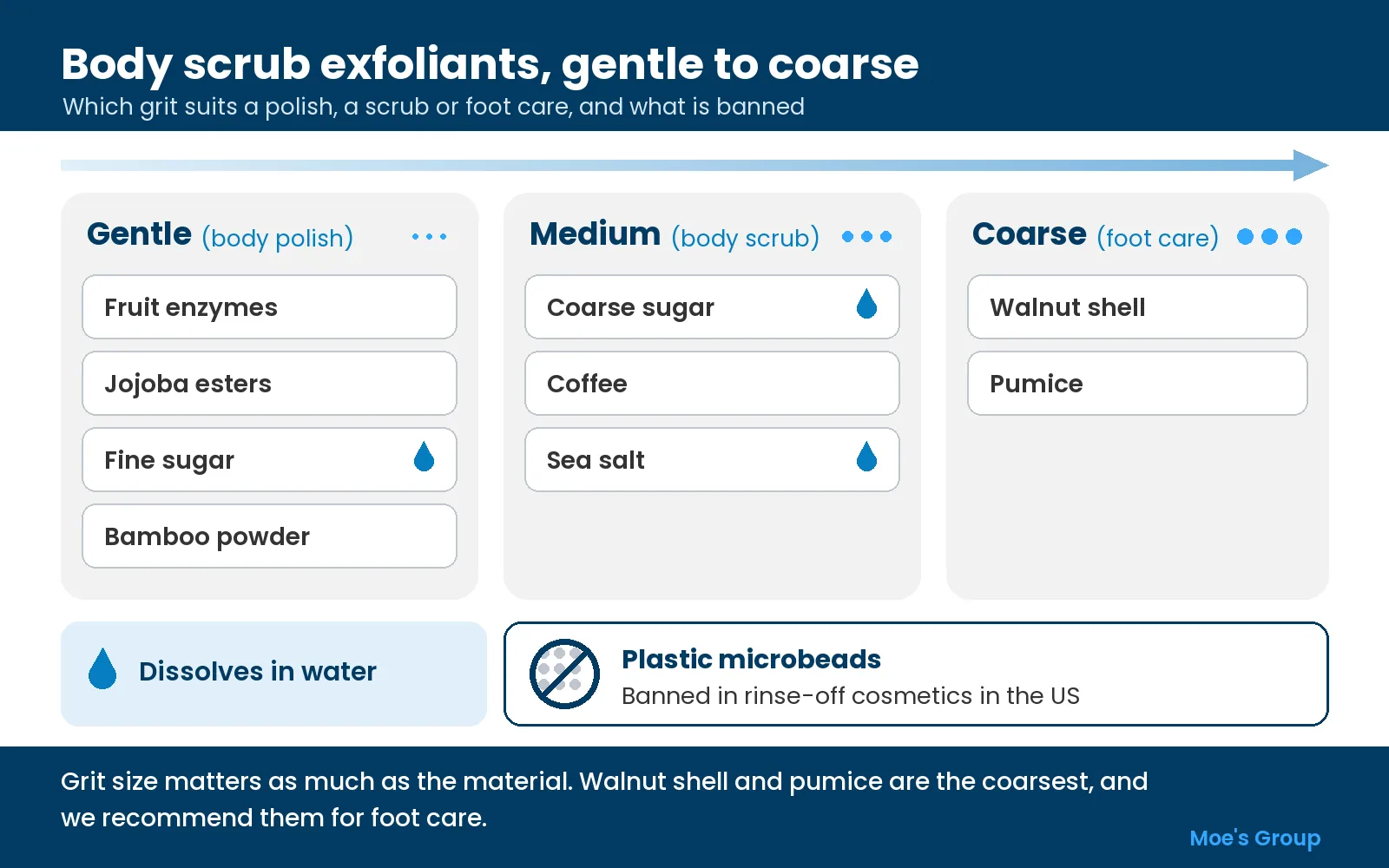
Sugar, salt, coffee, jojoba esters, bamboo powder and fruit enzymes such as papain and bromelain all work; plastic microbeads are banned. The Microbead-Free Waters Act of 2015 bans rinse-off cosmetics with intentionally added plastic microbeads, meaning solid plastic particles smaller than 5 millimeters used to exfoliate or cleanse, and California has banned their sale since January 1, 2020.
Grit size matters as much as the material. Fine sugar, jojoba esters and bamboo powder suit a polish; coarse sugar, sea salt and coffee suit a scrub. Walnut shell and pumice are the coarsest, and we recommend them for foot care rather than an all-over body scrub.
Should you launch a sugar scrub or a salt scrub?
For most first launches, sugar: it dissolves as it is used, feels gentler and suits more skin types. Salt is firmer and slower to dissolve, which suits a spa positioning, but it stings freshly shaved skin and corrodes metal lids, so plan a plastic lid and a direction to avoid freshly shaved skin. Coffee grounds need a supplier microbiology specification and can mark grout.
What goes wrong with body scrubs, and how do you prevent it?
Most scrub problems show up weeks after filling. These are the ones to plan for:
- Oil separation. Oil rises to the top of a sugar scrub in warm storage or shipping. The fix is the grit-to-oil ratio, plus butters or waxes that hold the oil, and warm and cold stability samples show it before production.
- Sugar dissolving in the jar. A creamy polish made with a water-based emulsion dissolves its own sugar. Sugar polishes need a water-free emulsifying base or an exfoliant that does not dissolve.
- Water from wet hands. An oil scrub holds no water in the jar, but it is used in a wet shower. Whether it needs a preservative is a formula decision, backed by a challenge test such as ISO 11930 on the finished product, or a documented low-risk assessment under ISO 29621.
- Slippery floors and settling. Oil scrubs leave the shower floor slippery, so many brands add a caution. Scrubs are semisolid, so the label declares net weight (21 CFR 701.13), and grit settling after filling is one more reason to fill by weight.
- Color drift. Vanillin and some other fragrance materials turn a white scrub tan, so fragrance should be tested in the scrub base before production.
How do sugar, salt, coffee and whipped scrubs compare?
They differ in base, grit, how they rinse and what goes wrong in the jar, so format is the first decision in your brief.
| Format | Base | Feel and rinse | Best packaging | What to watch |
|---|---|---|---|---|
| Sugar scrub | Oils and butters | Medium grit, dissolves as you use it, leaves an oil film | Wide-mouth jar | Oil separating on top |
| Salt scrub | Oils | Firmer grit, dissolves slowly | Jar with a plastic lid | Stings freshly shaved skin; corrodes metal lids |
| Coffee scrub | Oils, sometimes sugar | Coarse, strong scent, can mark grout | Jar or pouch | Raw-material microbiology |
| Whipped scrub | Whipped butter base | Airy, lighter grit | Jar or tub | Collapsing in heat |
| Foaming scrub | Surfactant (syndet) base plus grit | Lathers, rinses clean | Tub | Sugar dissolving if water is present |
| Body polish | Cream, emulsified oil or butter | Fine grit, rinses milky and smooth | Jar, tub or squeeze tube | Grit settling or dissolving |
| Enzyme or AHA polish | Cream or gel | Little or no grit | Squeeze tube or jar | pH, irritation and AHA labelling |
What are shoppers searching for in body scrubs?
Steady demand, spread across more brands. On Amazon in the US, “body scrub” drew about 327,000 searches in September 2026, level with about 320,000 in September 2024, while searches for the most-searched brand-name scrub fell by about a third.
The fastest-growing scrub search we checked, “turmeric body scrub”, rose from about 5,300 searches in September 2024 to about 27,600 in September 2026. Turmeric needs care: it stains grout, towels and nails yellow, and the directions should say so. Turmeric is not a color additive FDA permits in cosmetics, so it can only be there for a non-coloring role, with any color it gives clearly unimportant; color the scrub yellow with a permitted colorant instead.
What can a body scrub claim?
A body scrub can claim to exfoliate and to make skin look and feel smoother and softer; claims that it treats a condition or changes the body make it a drug under US law. FDA’s guidance “Is It a Cosmetic, a Drug, or Both? (Or Is It Soap?)” draws that line, and the FTC expects every claim to be substantiated. Any colorant, including micas and iron oxides, must be a color additive FDA permits for that use, and FDA’s 2005 guidance recommends a Sunburn Alert on cosmetics containing alpha hydroxy acids such as glycolic or lactic acid, so plan it into the label of an AHA polish. Our guide to when a body product becomes a drug covers body care in more detail.
| Can say (with substantiation on the finished product) | Cannot say (drug claim or unsupported) |
|---|---|
| Exfoliates; buffs away dull, dry-looking skin | Reduces cellulite; detoxifies; boosts circulation |
| Skin feels smoother and softer | Claims about acne, keratosis pilaris, eczema or ingrown hairs |
| Skin looks brighter and more even | Lightens dark spots; fades scars or stretch marks |
| Leaves skin feeling moisturized | Slims, tones or reshapes the body |
| Microbead-free (if no plastic particles are added) | Approved by the FDA |
Which body scrub formats can Moe’s Group make?
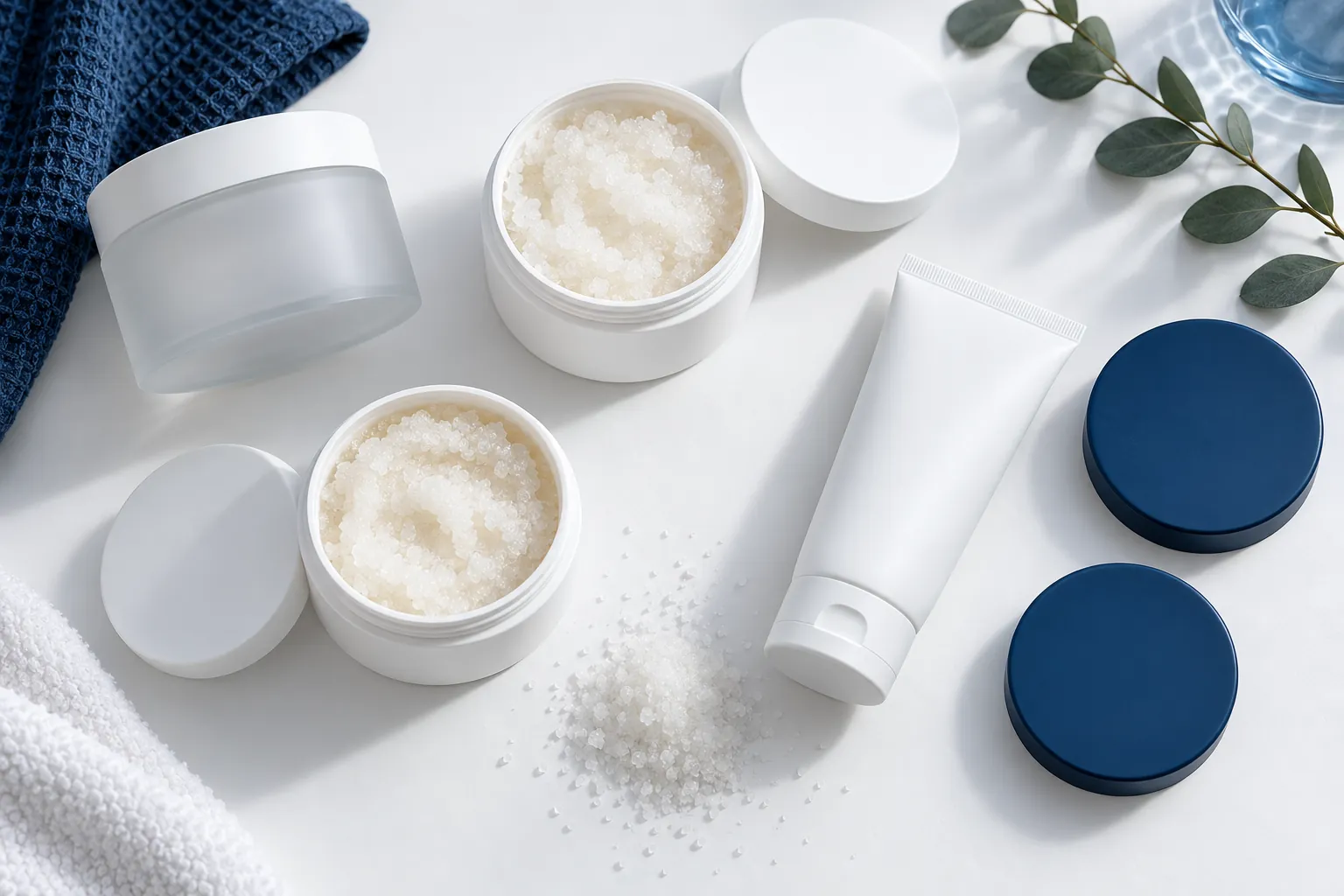
We make sugar and salt scrubs, body polishes and enzyme polishes with little or no grit. Scrubs go in wide-mouth jars and tubs, because fingers need to reach the grit; fine-grit polishes also work in squeeze tubes, while coarse grit clogs tubes and pumps. US labels need the ingredient list in descending order of predominance (21 CFR 701.3) and net weight in US and metric units (Fair Packaging and Labeling Act; 21 CFR 701.13). See our packaging page for components.
White label puts your brand on a ready formula, from 200 units where a ready formula exists. Private label is a custom formula developed to your brief, with the exfoliant, grit, scent and color you choose, from 1,000 units. Ask which ready scrub formulas are available when you request a quote.
How does a body scrub project work at Moe’s Group?
It runs in five steps, from brief to filled and labelled product, at our facility in Chatsworth, California.
- Send your brief. Format, exfoliant, scent, pack and volume, through the Request for Quote form.
- Formulation. Our in-house formulation team develops the scrub or polish, and you approve the sample.
- Stability and safety. Agree the testing the formula needs, such as warm and cold stability checks and a challenge test or a low-risk assessment; testing is scoped in your quote.
- Claims and label. Keep claims cosmetic and confirm the ingredient list and net weight before artwork goes to print; our guide to who files with the FDA covers MoCRA listing.
- Production. Filling and labelling run in house in Chatsworth.

Can Moe’s Group make your body scrub, and what is the MOQ?
Yes: Moe’s Group formulates, fills and labels private label body scrubs and body polishes in Chatsworth, California, custom private label from 1,000 units; white label from 200 units where a ready formula exists. We source the exfoliant, butters, oils and fragrance your brief calls for, and lead time is set out in your quote. For a matching set, we also make body wash, body lotion and bar soap. See private label body care manufacturing for the full range.
Frequently asked questions
What is the difference between a body scrub and a body polish?
A body scrub uses coarser grit, usually sugar or salt in oil or butter, and leaves an oil film. A body polish uses finer grit or enzymes in a creamier base and rinses off milky and smooth.
Sugar scrub or salt scrub: which should I launch first?
Usually sugar. It dissolves as it is used and feels gentler on more skin types. Salt is firmer and suits a spa positioning, but it stings freshly shaved skin and can corrode metal lids.
Are plastic microbeads allowed in body scrubs?
No. The Microbead-Free Waters Act of 2015 bans them in rinse-off cosmetics, and California has banned their sale since January 1, 2020. Sugar, salt, coffee, jojoba esters or fruit enzymes do the job instead.
Why does oil separate on top of a sugar scrub?
Usually there is too much oil for the grit, or the scrub was stored warm. The grit-to-oil ratio and butters or waxes control it, and warm and cold stability samples show it before production.
Does an oil-based body scrub need a preservative?
Often, yes. The jar holds no water, but the scrub is used in a wet shower. The decision should be backed by a challenge test on the finished product, or a documented low-risk assessment under ISO 29621.
Can you match a body scrub to a body wash and lotion in the same scent?
Yes. We also make body wash, body lotion and bar soap, so one fragrance can run across a set; test it in each base before production.
Does a body scrub have to be approved by the FDA?
No. Cosmetic products and ingredients, other than color additives, do not need approval from the FDA before sale. Under MoCRA the responsible person, usually the brand, lists the product unless exempt as a small business and keeps its safety substantiation, and the facility must be registered; ours is FDA-registered.
What is the minimum order for a private label body scrub?
At Moe’s Group the minimum order is custom private label from 1,000 units; white label from 200 units where a ready formula exists. Lead time depends on the formula and is set out in your quote.
Related pages
- Private label body care manufacturing
- Private label body oil and body glaze manufacturing
- Private label self-tanner manufacturing
- Private label bar soap manufacturing
- Private label hand cream and foot care manufacturing
- Private label women’s body care manufacturing
- Private label body wash manufacturing
- Private label body products: cosmetic or drug?
- Our California skincare manufacturing facility
- Certifications and FDA facility registration
Sources
- U.S. Food and Drug Administration, “Is It a Cosmetic, a Drug, or Both? (Or Is It Soap?)”
- U.S. Food and Drug Administration, “The Microbead-Free Waters Act: FAQs”; Microbead-Free Waters Act of 2015, Public Law 114-114 (21 U.S.C. 331(ddd)); California Public Resources Code sections 42360 to 42365 (AB 888, 2015)
- U.S. Food and Drug Administration, “Guidance for Industry: Labeling for Topically Applied Cosmetic Products Containing Alpha Hydroxy Acids as Ingredients” (January 2005)
- U.S. Food and Drug Administration, “Modernization of Cosmetics Regulation Act of 2022 (MoCRA)”
- 21 CFR 701.3 and 701.13 (ingredient and net quantity labelling); 21 CFR 73.600 and 73.615 (turmeric, listed for food only) and 70.3(f) and (g) (color additive definition); Fair Packaging and Labeling Act, 15 U.S.C. 1453(a)(2)
- ISO 11930 (preservative efficacy testing); ISO 29621 (microbiological risk assessment of low-risk products)
- Federal Trade Commission, “Health Products Compliance Guidance” (December 2022)
- Amazon US search volume estimates for body scrub and related terms, September 2024 to September 2026, VOC.ai keyword data pulled October 28 and 29, 2026
Start a body scrub product
Tell us the format, the exfoliant, the scent and the volume, and our chemists will come back with options and a quote. Prefer to talk it through first? Book a free consultation.