
A private label bar soap manufacturer makes bars to a brand’s formula, scent, size and wrap, sold under the brand’s own name. The first decision is whether the bar is a true soap, a cosmetic or a drug, because that decides who regulates it and what the label must say, and most private label bars turn out to be cosmetics. Moe’s Group LLC makes private label bar soap in house at its FDA-registered facility in Chatsworth, California: custom private label from 1,000 units; white label from 200 units where a ready formula exists. Our ISO 22716, ISO 9001 and ISO 45001 certificates, which cover skin care, hair care and oils, are on the certifications page.
Last updated: October 2026
| Private label bar soap manufacturing at a glance | Detail |
|---|---|
| Manufacturer | Moe’s Group LLC |
| Facility | 9743 Independence Ave, Chatsworth, CA 91311 (Los Angeles) |
| Product | Private label bar soap, made in house in Chatsworth |
| Bar types covered on this page | Cold process, hot process, melt-and-pour (glycerin), milled, syndet beauty bars, shampoo bars |
| Bar process | Named in your written quote |
| Service models | Custom private label; white label where a ready formula exists |
| Minimum order | custom private label from 1,000 units; white label from 200 units where a ready formula exists |
| Classification | Set by your claims: true soap, cosmetic or drug (see the table below) |
| Labelling | In house, in Chatsworth |
| Quality | FDA-registered facility; ISO 22716, ISO 9001 and ISO 45001 for skin care, hair care and oils |
| Contact | +1 (866) 777-6751 or the Request for Quote form |
What does a private label bar soap manufacturer do?
It turns your brief into a finished, wrapped bar: formula, scent, color, size, shape, wrap and labels. A good private label soap manufacturer also tells you, before artwork, whether your bar is a true soap, a cosmetic or a drug.
Demand is steady rather than surging: estimated Amazon US searches for the term bar soap rose about 20% in the year to September 2026 (VOC keyword data, pulled October 28, 2026), with growth in generic and long-tail searches rather than legacy brand names.
Is your bar a true soap, a cosmetic or a drug?
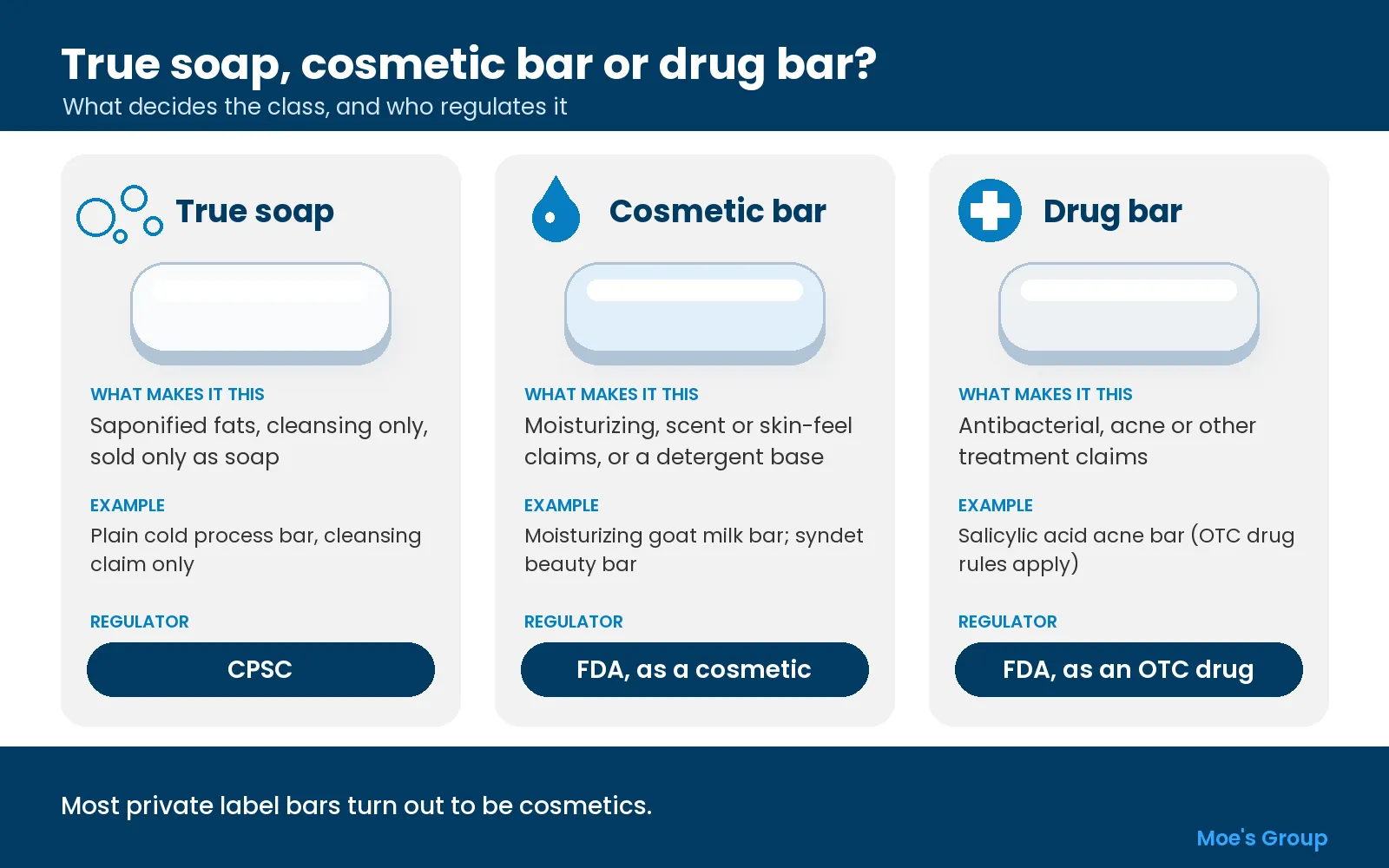
Under 21 CFR 701.20, a bar is a true soap only if most of its non-volatile matter is alkali salts of fatty acids, its cleansing comes from those salts alone, and it is labeled, sold and represented only as soap. True soap is regulated by the Consumer Product Safety Commission (CPSC), not the FDA. A moisturizing, deodorizing or scent claim, or a synthetic detergent base, makes the bar a cosmetic. A germ-killing claim, or a claim about acne or eczema, makes it a drug, and a bar can be a cosmetic and a drug at once.
| True soap | Cosmetic bar | Drug bar | |
|---|---|---|---|
| What makes it this | Saponified fats, cleansing only, sold only as soap | Moisturizing, scent or skin-feel claims, or a detergent base | Antibacterial, acne or other treatment claims |
| Regulator | CPSC | FDA, as a cosmetic | FDA, as an OTC drug |
| Ingredient list | Not required by CPSC | Required (21 CFR 701.3) | Drug Facts panel, including inactive ingredients |
| Net weight | FTC packaging rules (16 CFR Part 500) | Required, in ounces and grams (21 CFR 701.13) | Required |
| Example | Plain cold process bar, cleansing claim only | Moisturizing goat milk bar; syndet beauty bar | Salicylic acid acne bar (OTC drug rules apply) |
Most brands want to say moisturizing or sell the scent, so most bars are planned as cosmetics from the start; CPSC adds that ingredients with cosmetic properties can make a bar a cosmetic even with no claim. Body washes and lotions follow the same test: see our guide to whether private label body products are cosmetics or drugs.
Which bar soap processes can a brand choose from?
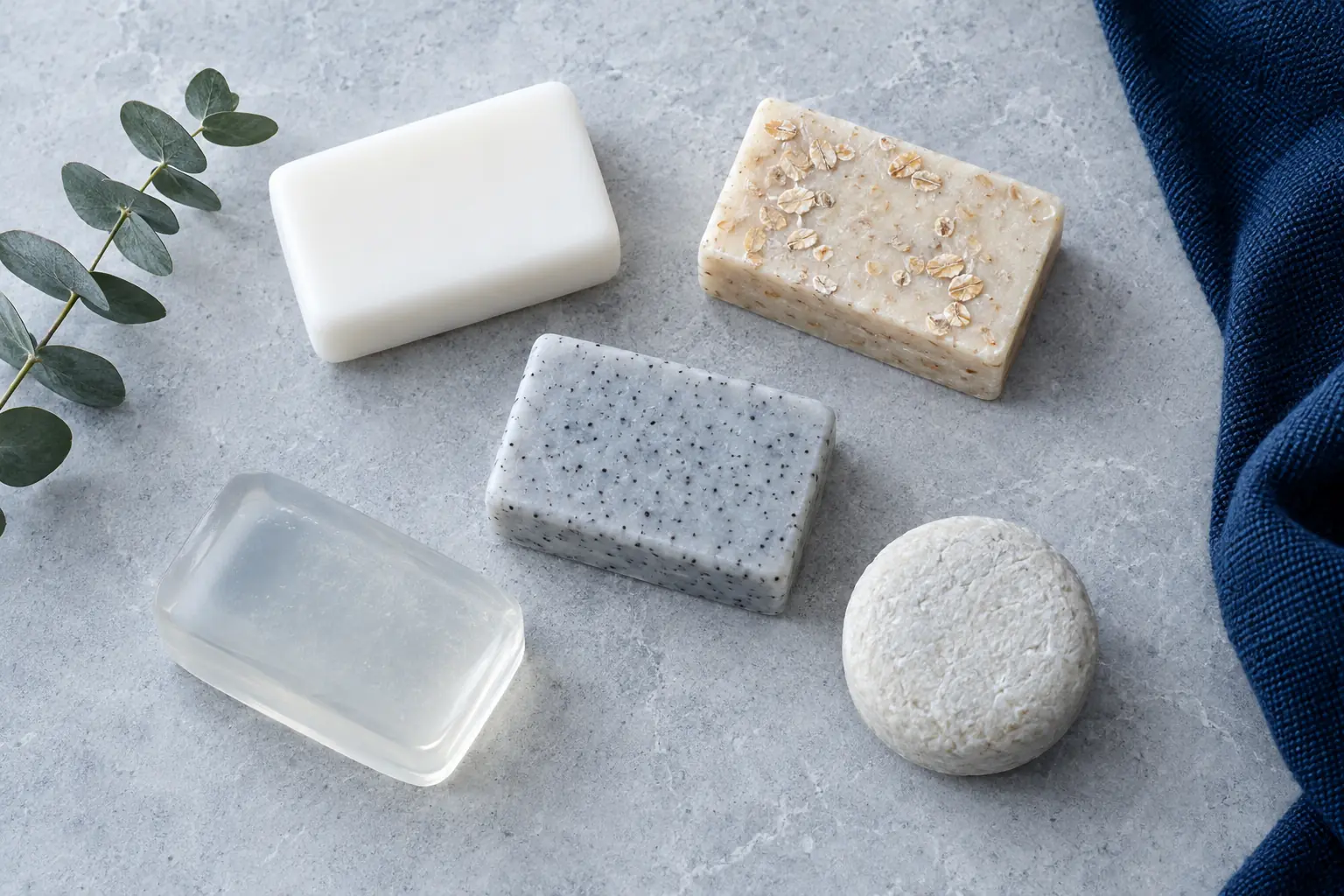
Five processes cover almost every private label bar. Cold process bars have the handmade look and vary from batch to batch; milled bars are hard, consistent and logo-stamped; syndet bars are never true soaps. Your written quote names the process for your bar.
| Process | How it is made | Cure (industry norm) | Typical buyer |
|---|---|---|---|
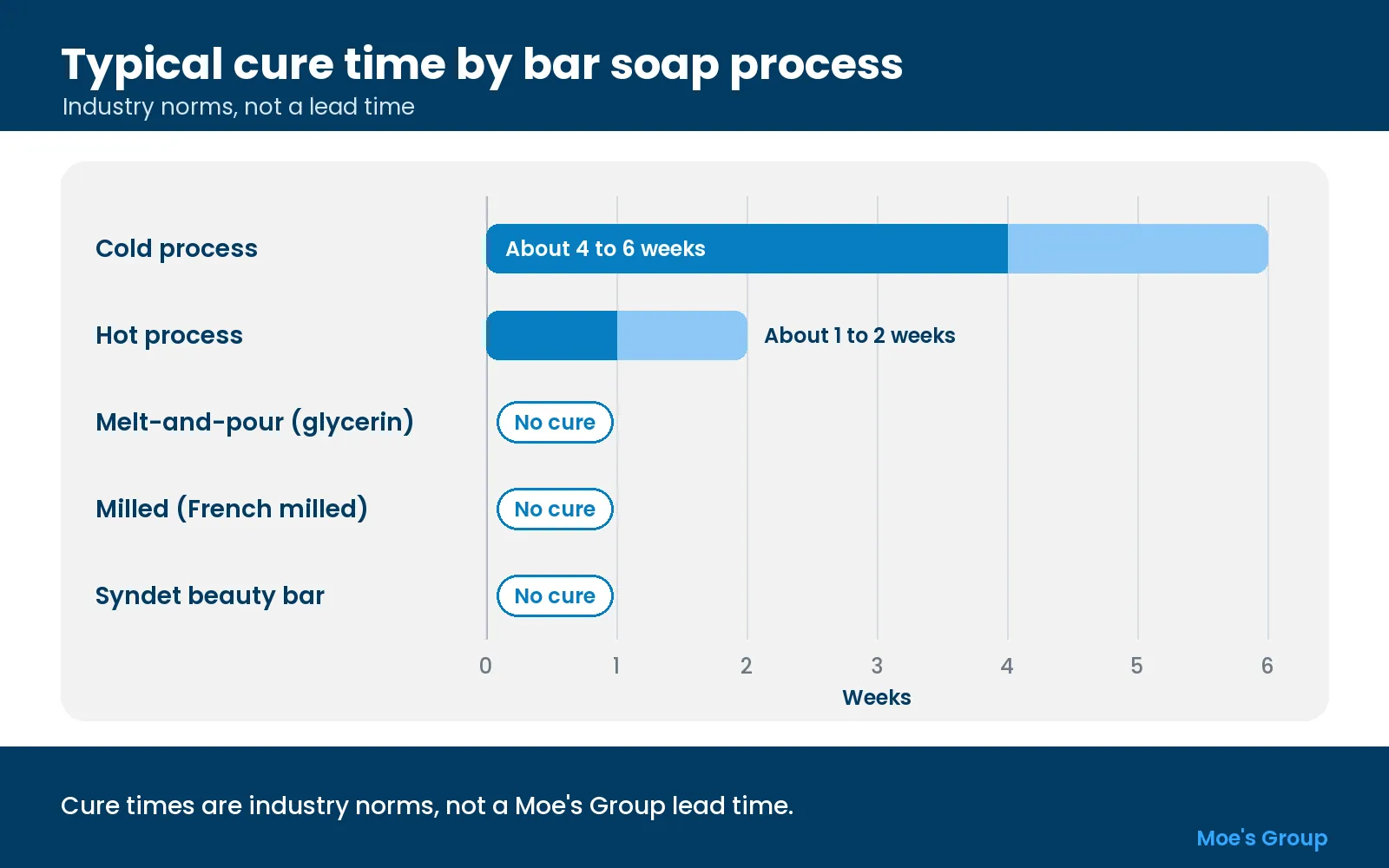
| Cold process | Oils and lye mixed, poured into loaves, cut | About 4 to 6 weeks | Natural, tallow and goat milk brands |
| Hot process | As cold process, cooked in a kettle | About 1 to 2 weeks | Rustic, handmade brands |
| Melt-and-pour (glycerin) | Ready base melted, scented and poured | None | Gift, novelty and seasonal bars |
| Milled (French milled) | Soap noodles milled, extruded and stamped | None | Hotel, retail and volume brands |
| Syndet beauty bar | Synthetic cleansers pressed into a bar | None | Sensitive-skin positioning |
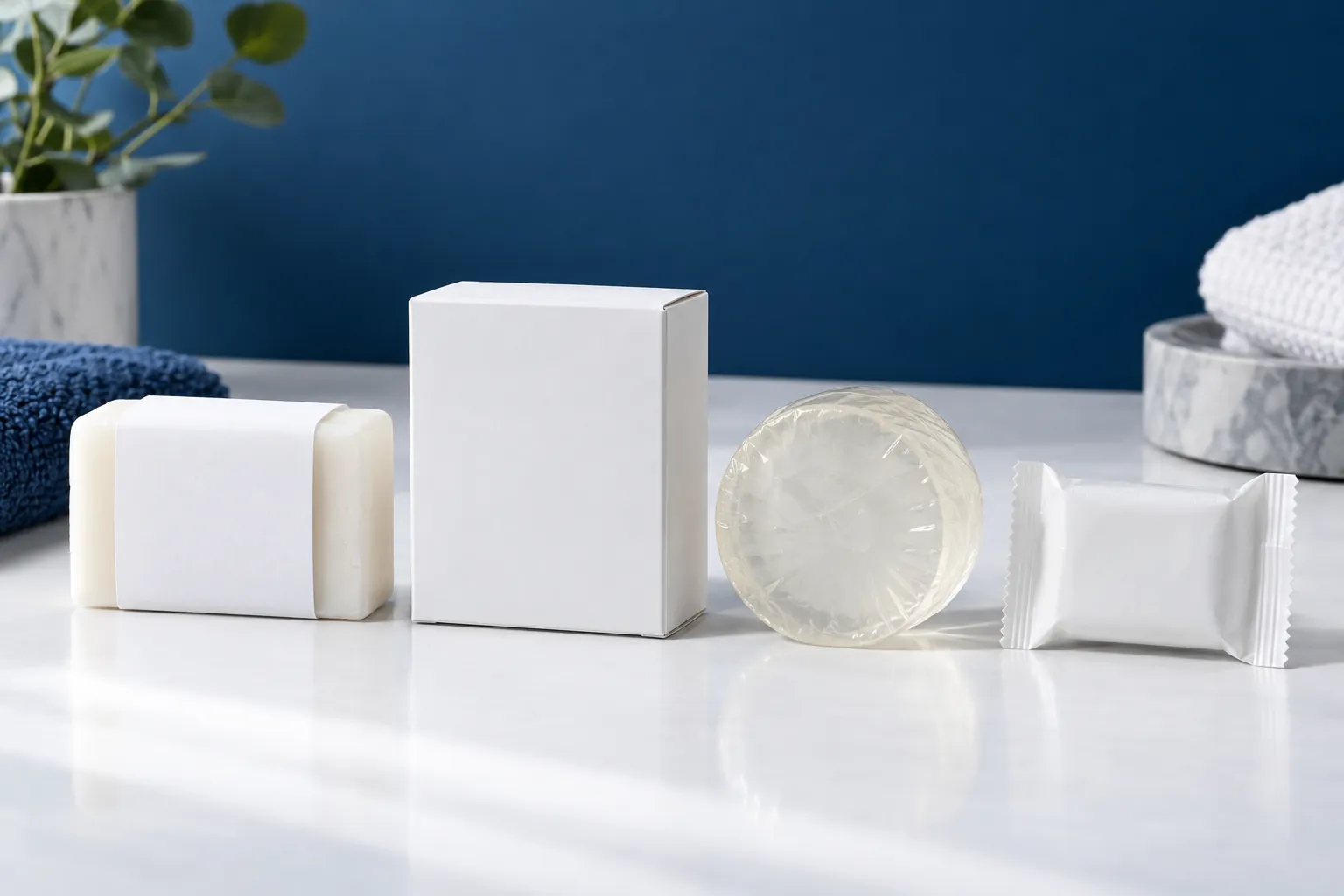
Most melt-and-pour bases contain added synthetic surfactants, so they usually fail the true soap test and are labeled as cosmetics.
How long does bar soap take to cure?
Cold process bars cure for about 4 to 6 weeks as an industry norm, hot process bars for less, and the other processes need no cure. Water evaporates, so the bar hardens and loses weight. Your quote sets the timing; we don’t publish a standard lead time.
What goes wrong with private label bar soap?
Most problems show up after production. These are the ones to plan for.
- Underweight bars. Cold process bars lose water as they cure. Declare the net weight of the cured bar, not the fresh-cut one.
- Sweating glycerin bars. Melt-and-pour bases draw moisture from humid air, so they need a tight wrap such as shrink film.
- Fragrance surprises. Some fragrance oils make cold process soap set too fast, and vanillin turns bars brown. Test the exact fragrance in the exact base.
- Soda ash and color drift. A white film or fading natural colors look like defects. Approve a cured sample, not a fresh one.
- Unapproved colorants. Every colorant in a cosmetic bar, micas and iron oxides included, must be listed in FDA’s color additive regulations for that use.
What goes on a bar soap label and wrap?
A cosmetic bar needs an ingredient list in descending order of predominance (21 CFR 701.3), a net weight in both ounces and grams (21 CFR 701.13 and the Fair Packaging and Labeling Act), the name and address of the manufacturer, packer or distributor, and, under the Modernization of Cosmetics Regulation Act (MoCRA), a US contact for adverse event reports. Saponified oils appear by their soap names, such as Sodium Tallowate. A true soap needs no ingredient list under CPSC, and its net quantity falls under the FTC’s packaging rules. Paper wraps suit cold process bars; shrink film protects glycerin bars from humidity.
What can a bar soap claim?
Cleansing claims keep a true soap a true soap, appearance and feel claims make it a cosmetic, and treatment claims make it a drug. Back each claim with testing of your finished bar.
- Cleanses; washes away dirt and oil. Fine for a true soap or a cosmetic.
- Leaves skin feeling soft; moisturizing; scented with cedar. Cosmetic claims.
- Brighter-looking skin. Cosmetic, if substantiated; removes dark spots is a drug claim.
- Antibacterial; kills 99.9% of germs. OTC drug claims, under FDA’s antiseptic wash rules.
- Acne or eczema claims. Drug claims, whatever the base.
Which bar soap formats and formulas can a brand choose?
- Tallow soap. A natural fit beside tallow skincare; about 4,400 US Google searches a month.
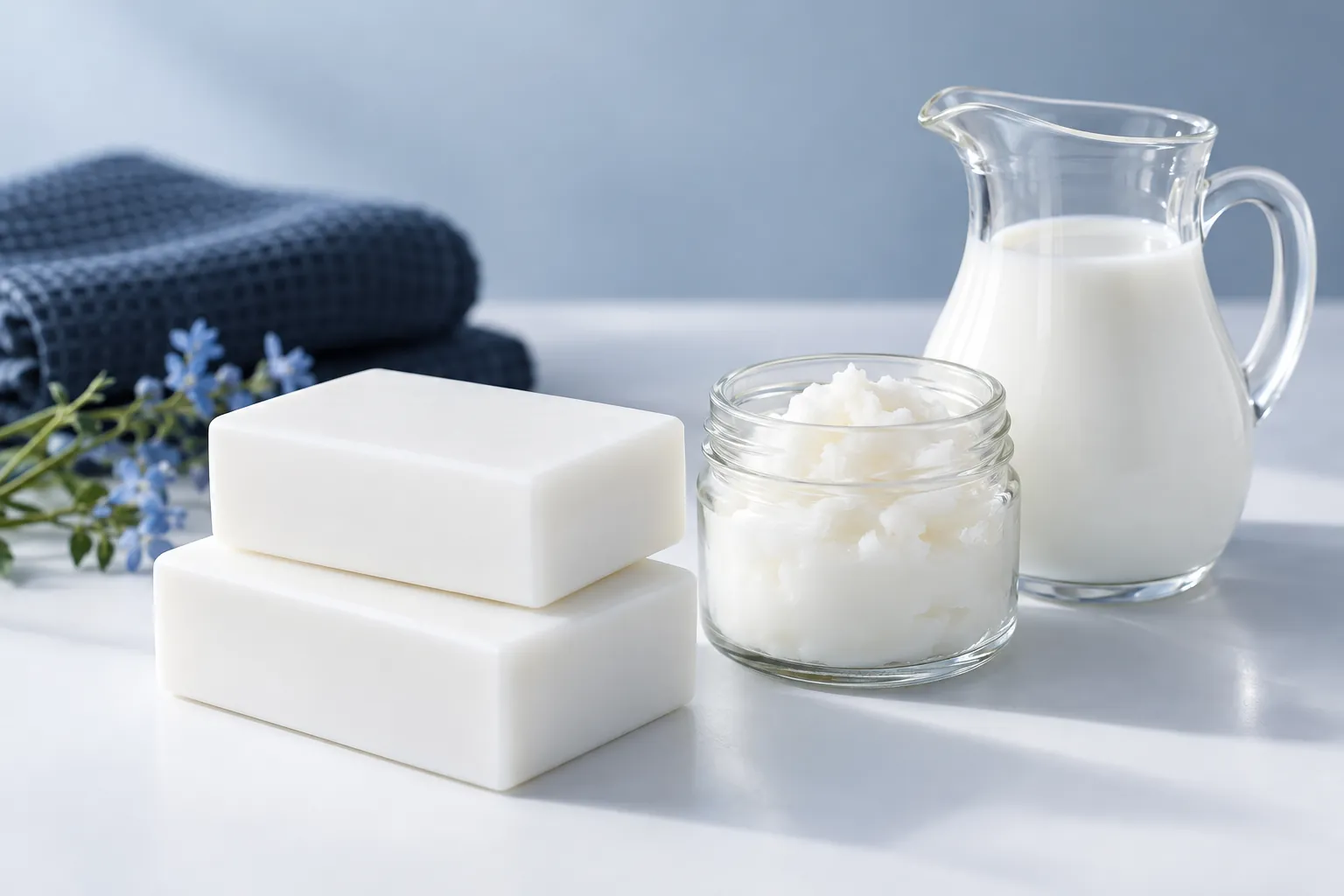
- Goat milk and oatmeal bars. Large and steady: goat milk soap draws about 18,100 US Google searches a month.
- Exfoliating bars. Oats, ground seeds or pumice; plastic microbeads are banned in rinse-off cosmetics.
- Clear, K-beauty-style bars. Usually transparent glycerin bases, labeled as cosmetics.
- Men’s bars. Bold scents and bigger bars, often sold beside a body wash.
- Shampoo bars. Usually syndet bars, because true soap is alkaline; see our hair care manufacturing page.
- Kojic acid bars. Keep claims to brighter-looking skin; dark spot removal is a drug claim.
How does a bar soap project work at Moe’s Group?
It runs in five steps, from brief to finished bar, made at our facility in Chatsworth, California.
- Send your brief. Bar type, scent, size, claims, wrap and volume, through the Request for Quote form.
- Settle the classification. Use the table above to confirm whether your claims make the bar a true soap, a cosmetic or a drug, before any artwork.
- Get a written quote. It names the process, the bar size, the wrap and the timing.
- Approve a finished sample. You sign off scent, color, weight and lather on a finished bar (cured, for cold process), not a fresh one.
- Production. Your bars are made in house in Chatsworth and labeled to the approved sample, from 1,000 units for a custom formula.

Can Moe’s Group make private label bar soap, and what is the MOQ?
Yes: Moe’s Group makes private label bar soap in house in Chatsworth, California: custom private label from 1,000 units; white label from 200 units where a ready formula exists. White label is a ready bar formula under your brand; private label is a custom formula. The process for your bar and the lead time are set out in your quote. The facility is FDA registered, not approved; the FDA does not approve cosmetics. See our private label body care manufacturing page for the full body care range.
Frequently asked questions
What is the difference between true soap and a cosmetic bar?
A true soap is mostly saponified oils or fats, cleans only through that soap and is sold only as soap, so the CPSC regulates it. A moisturizing or scent claim, or a detergent base, makes it an FDA-regulated cosmetic.
Cold process or melt-and-pour: which is better for a brand?
Cold process suits a handmade story but needs weeks to cure and varies by batch. Melt-and-pour needs no cure and looks consistent, but the base is bought in, so it is harder to make distinctive.
How long does cold process soap take to cure?
About 4 to 6 weeks as an industry norm. Declare the net weight of the cured bar, because bars lose water as they cure.
Can I private label tallow soap or goat milk soap?
Yes. Moe’s Group makes private label bars in house in Chatsworth, and your written quote names the formula and process for a tallow or goat milk bar. A moisturizing claim on either bar makes it a cosmetic.
Can a bar soap be called antibacterial?
Only as an OTC drug. An antibacterial or germ-killing claim makes the bar a drug, and FDA’s 2016 rule removed triclosan and 18 other actives from consumer antiseptic washes.
Can I add essential oils or exfoliants to my bar?
Yes. Essential oils sold for scent make the bar a cosmetic. Exfoliants can be oats, ground seeds or pumice, but not plastic microbeads, which are banned in rinse-off cosmetics.
Does bar soap have to be approved by the FDA?
No. The FDA does not approve cosmetics before sale, except color additives, and a true soap is not FDA-regulated at all. A cosmetic bar falls under MoCRA: the brand lists it with the FDA unless a small-business exemption applies, and the label gives an adverse event contact.
What is the minimum order for private label bar soap?
At Moe’s Group the minimum order is custom private label from 1,000 units; white label from 200 units where a ready formula exists. Bars are made in house in Chatsworth. Lead time depends on the formula and is set out in your quote.
Related pages
- Private label body care manufacturing
- Private label men’s body care manufacturing
- Private label body scrub and body polish manufacturing
- Private label hand cream and foot care manufacturing
- Private label body wash manufacturing
- Tallow skincare manufacturing
- Private label body products: cosmetic or drug?
- Cosmetic packaging
- Our California skincare manufacturing facility
- Certifications and FDA facility registration
Sources
- FDA, “Frequently Asked Questions on Soap” (content current as of August 20, 2024) and “Is It a Cosmetic, a Drug, or Both? (Or Is It Soap?)”
- 21 CFR 701.20, Definition of the term soap
- CPSC, “Soap” FAQ
- 21 CFR 701.3 (ingredient labeling) and 21 CFR 701.13 (net quantity of contents); FTC Fair Packaging and Labeling Act regulations, 16 CFR Part 500
- FDA final rule on consumer antiseptic wash products (September 2016); Microbead-Free Waters Act of 2015; MoCRA (2022); FDA color additive regulations (21 CFR Parts 73 and 74)
- VOC Amazon US keyword estimates and Keywords Everywhere Google US volumes for bar soap terms, pulled October 28, 2026
Start a bar soap product
Tell us the bar type, scent, size, claims and volume, and we’ll come back with options and a quote. Prefer to talk it through first? Book a free consultation.