
A private label self-tanner is a sunless tanning product, usually a mousse, gradual lotion, face drops or mist, made with dihydroxyacetone (DHA) and sold under your brand. DHA browns the outermost layer of skin, so the tan develops over a few hours and fades in about a week, and in the US DHA is a color additive with its own label rules. Moe’s Group LLC formulates, fills and labels private label self-tanners at its FDA-registered facility in Chatsworth, California: custom private label from 1,000 units; white label from 200 units where a ready formula exists. Our ISO 22716, ISO 9001 and ISO 45001 certificates are on the certifications page.
Last updated: October 2026
| Private label self-tanner manufacturing at a glance | Detail |
|---|---|
| Manufacturer | Moe’s Group LLC |
| Facility | 9743 Independence Ave, Chatsworth, CA 91311 (Los Angeles) |
| Product | Sunless self-tanner made with dihydroxyacetone (DHA) |
| Common formats | Tanning mousse (foaming pump), gradual tan lotion, face tanning drops, tanning gel or serum, water-based tanning mist |
| Service models | Custom private label; white label where a ready formula exists |
| Minimum order | custom private label from 1,000 units; white label from 200 units where a ready formula exists |
| Raw material documents | DHA supplier spec sheet and certificate of analysis: ask for them with your quote |
| Formulation | In house, by our own chemists |
| Filling and labelling | In house, in Chatsworth |
| Quality | FDA-registered facility; ISO 22716 cosmetics GMP, ISO 9001, ISO 45001 |
| Contact | +1 (866) 777-6751 or the Request for Quote form |
What is a self-tanner, and how does DHA work?
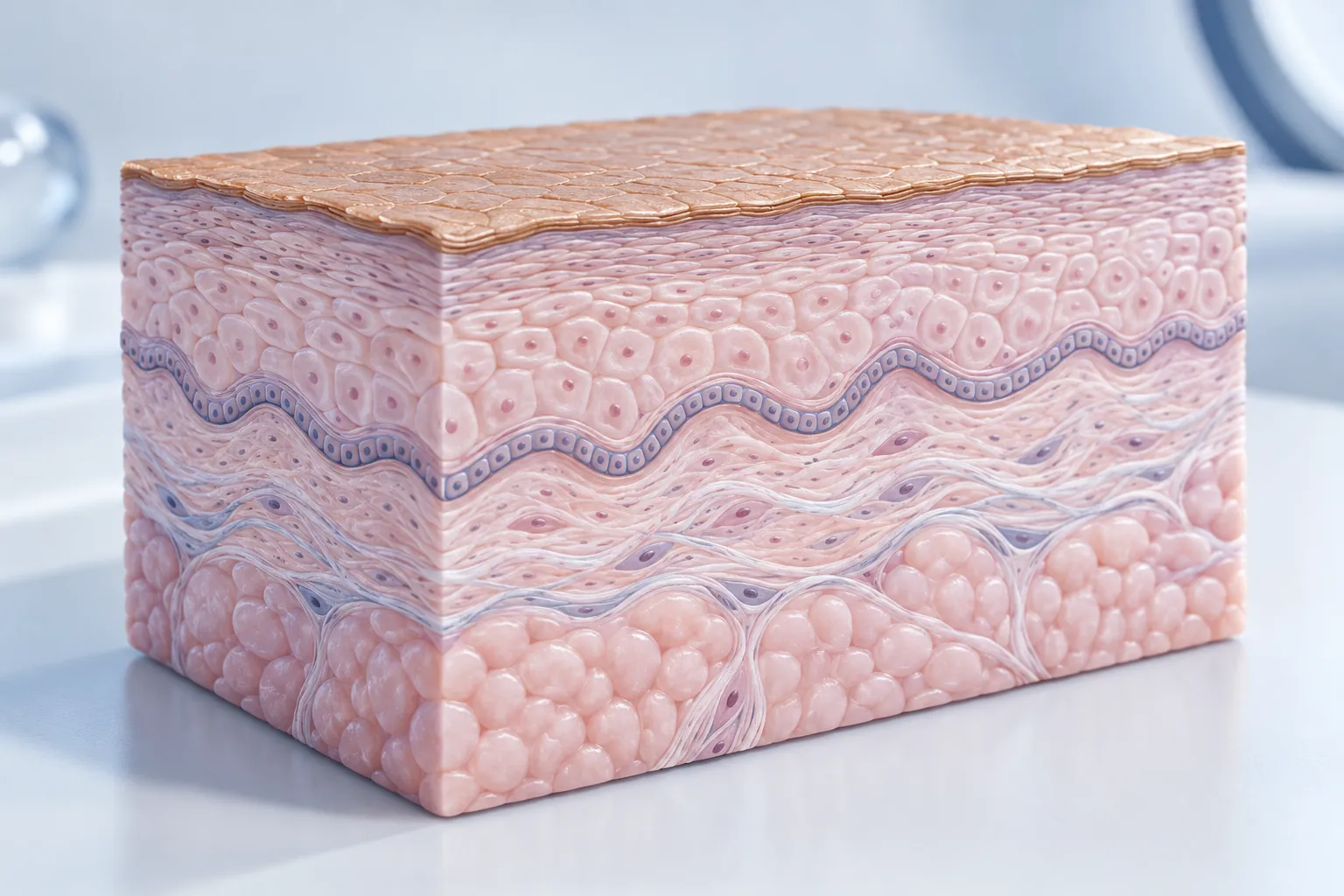
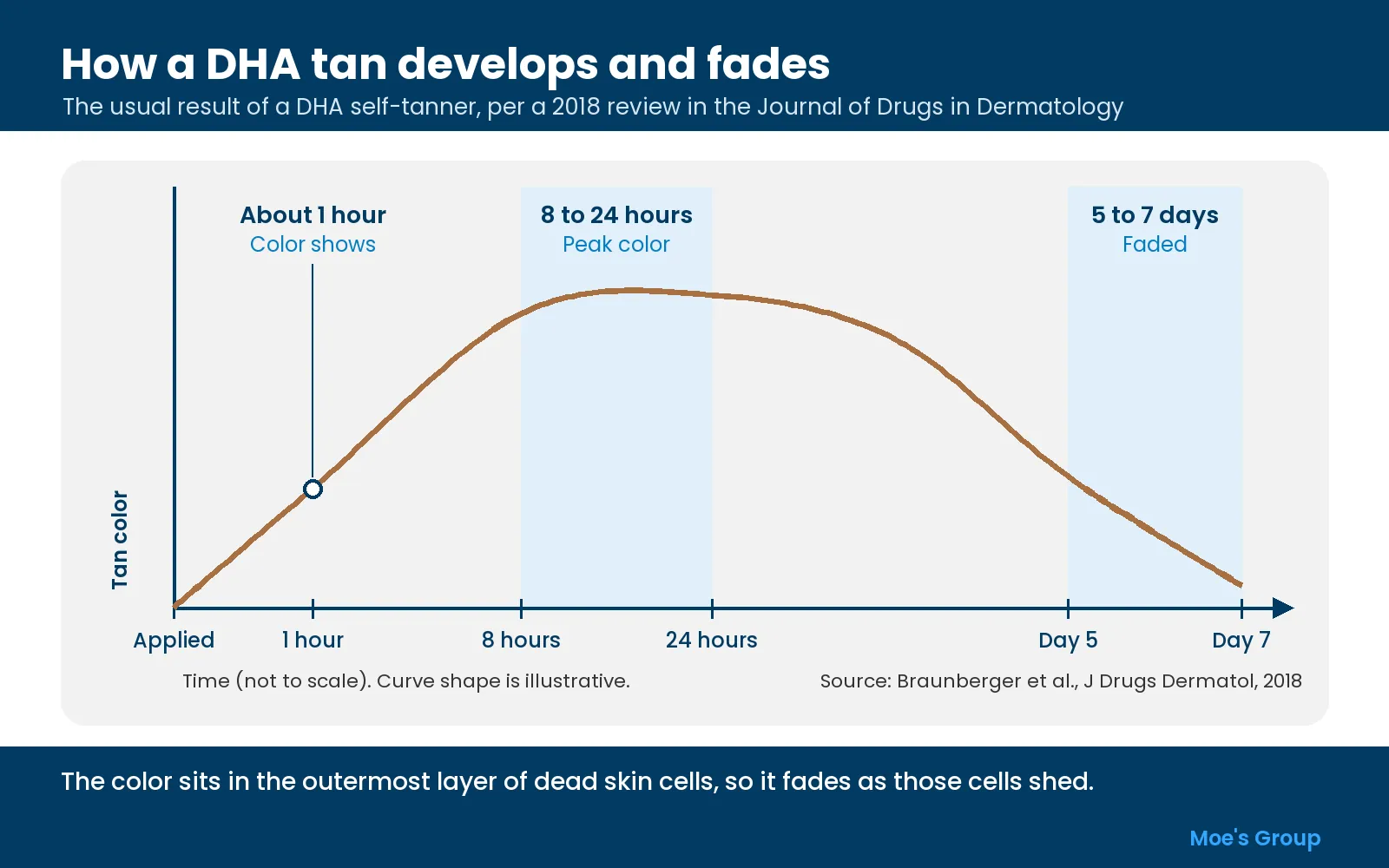
A self-tanner is a cosmetic that colors skin without sun, and almost all US self-tanners use dihydroxyacetone (DHA). DHA reacts with amino acids in the outermost layer of dead skin cells, the stratum corneum, in a browning (Maillard) reaction, so the tan fades as those cells shed. A 2018 review in the Journal of Drugs in Dermatology puts the usual result at color within an hour, a peak at 8 to 24 hours and a tan that lasts 5 to 7 days.
How much DHA should a self-tanner contain?
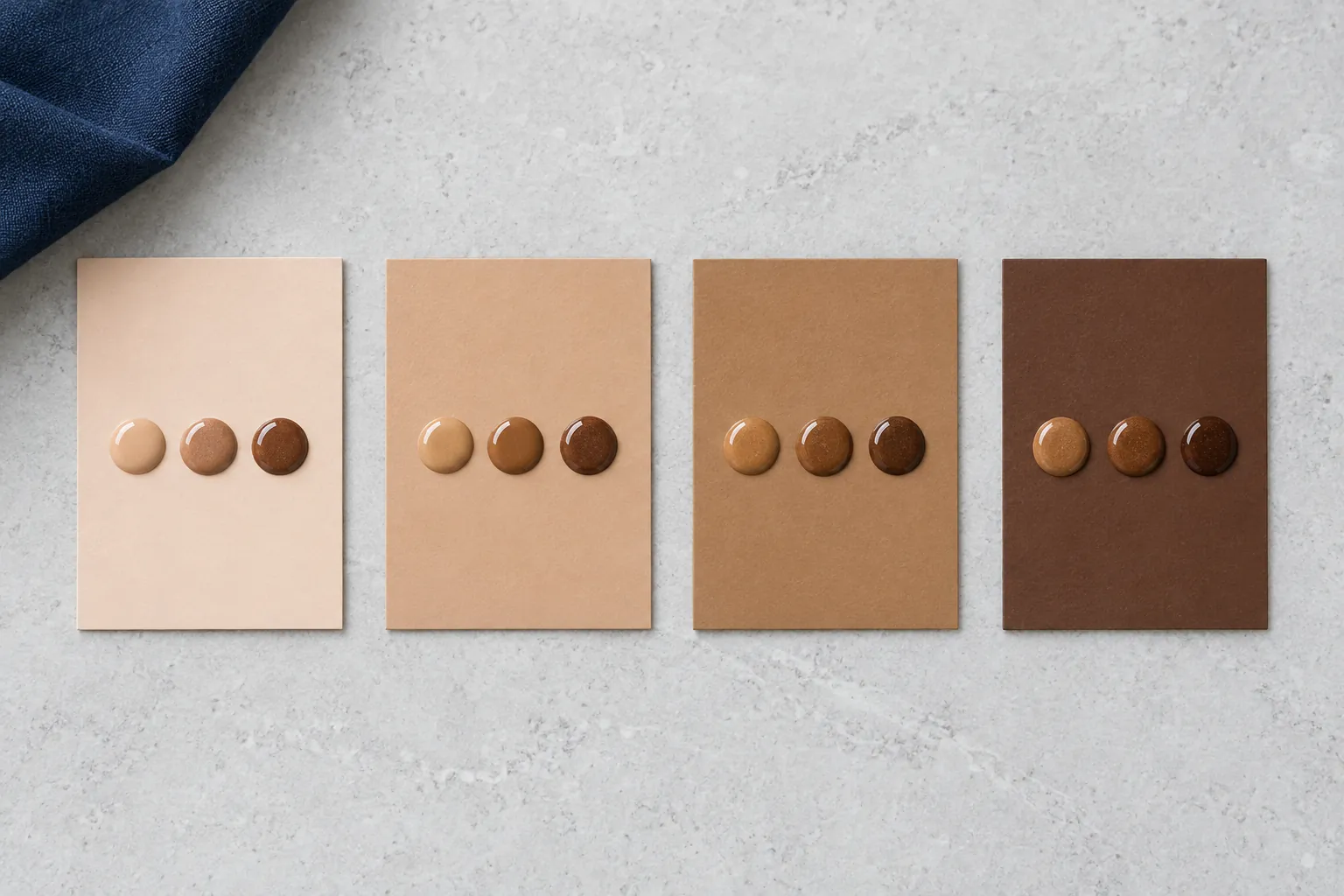
Most marketed self-tanners contain 3% to 5% DHA, according to the 2018 review; gradual lotions sit at the low end, and express or dark formulas go higher. FDA’s listing doesn’t set a maximum: it allows DHA in amounts consistent with good manufacturing practice. The right level depends on the shade, the number of applications and the customer, since one formula looks deeper on olive skin than on very fair skin. Set the level with your chemist and check it on skin-tone swatches before production.
What goes wrong when self-tanner is made?
Orange color, smell and formulas that stop working on the shelf usually start in the bottle:
- DHA breaks down with heat and higher pH. Patent and supplier data put its most stable point at about pH 4, with a finished-product range of about pH 3.5 to 5, and heat speeds the breakdown. That is why DHA is usually added during cool-down, with a pH specification checked at batch release.
- DHA reacts with amino acids in the bottle, too. Peptides, proteins and collagen can brown the formula before it reaches skin, so a skincare-boosted tanner needs ingredients chosen to avoid that.
- Orange tones and smell come from the same reaction. Too much DHA for the skin tone reads orange, and the reaction leaves a scent. Shade work and fragrance reduce both; nothing removes the smell entirely.
- Packaging changes stability. Light, air and heat shorten shelf life, so test stability in the pack you will sell.
Can a self-tanner include bronzers, guide colors or erythrulose?
Yes for bronzers and guide colors, with listed color additives only; erythrulose needs a regulatory decision first. A guide color is a wash-off tint that shows where the product has gone. It must be a color additive FDA lists for that use, such as caramel (21 CFR 73.2085), iron oxides (73.2250) or mica (73.2496); FD&C dyes also need FDA-certified batches. Check compatibility first: supplier data warn that DHA can lose its effect or discolor alongside iron oxides, titanium dioxide, zinc oxide or AHAs. Erythrulose, often paired with DHA, is not listed as a color additive anywhere in Title 21 (eCFR search, October 28, 2026), so get regulatory advice before it goes on a US label.
How do FDA rules shape a self-tanner label?
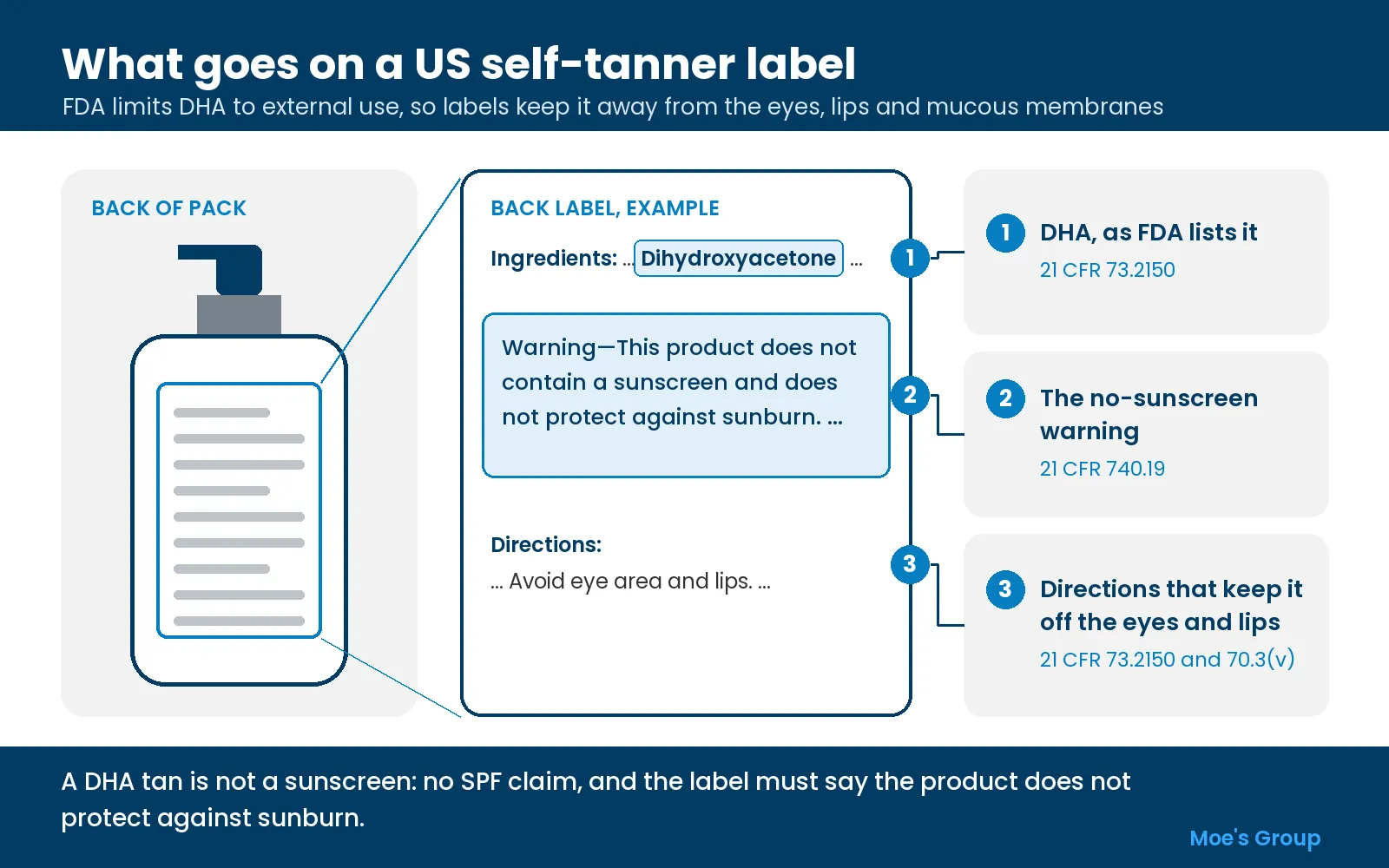
Two FDA rules shape it. DHA is listed at 21 CFR 73.2150 for externally applied cosmetics; FDA says it is not permitted in the area of the eye, and externally applied excludes the lips and areas covered by mucous membrane (21 CFR 70.3(v)). FDA limits DHA to external use, so labels keep it away from the eyes, lips and mucous membranes, usually with a directions line. Under 21 CFR 740.19, a tanning product without a sunscreen, including one that tans with DHA, must carry this warning:
Warning—This product does not contain a sunscreen and does not protect against sunburn. Repeated exposure of unprotected skin while tanning may increase the risk of skin aging, skin cancer, and other harmful effects to the skin even if you do not burn.
The FDA does not approve cosmetics before sale; the brand is responsible for safety substantiation, product listing and adverse-event reporting under MoCRA. Don’t assume MoCRA’s small-business exemption applies: it excludes products intended to alter appearance for more than 24 hours where removal is not part of normal use (21 U.S.C. 364h), and a DHA tan lasts days. See who files with the FDA for private label cosmetics.
Can you make spray-tan solution for salons?
Ask us first, because this is the one self-tanner format FDA has flagged. FDA has not approved DHA as an all-over spray in tanning booths, because no safety data for that use have been submitted, and says a booth makes it hard to keep DHA off the eyes, lips and mucous membranes. Salon airbrush solutions are widely sold, but their directions and warnings need regulatory review. If a salon line is in your plan, put it in your brief and we will tell you with your quote whether we can make it. The booth concern doesn’t apply to the hand-applied formats on this page.
What can a self-tanner claim?
Claims about how the tan looks and feels are cosmetic; claims about sun protection or changing how skin tans make the product a drug, per FDA’s guidance “Is It a Cosmetic, a Drug, or Both? (Or Is It Soap?)”. The FTC expects every claim to be substantiated, so base claims on testing of your finished product. Our guide to cosmetic or drug body products covers the wider category.
| Can say (with substantiation on the finished product) | Cannot say (drug claim or unsupported) |
|---|---|
| Gives skin a natural-looking sunless tan or glow | Protects from the sun, prevents sunburn, or any SPF number |
| Builds color gradually over several applications | Boosts melanin, accelerates or stimulates your natural tan |
| Even-looking, streak-free finish; fast-drying | Firms skin or reduces cellulite |
| Moisturizes skin while it tans (if the formula does) | Treats vitiligo or any other skin condition |
| Fragrance-free or vegan (if every ingredient supports it) | Safer than sun tanning; approved by the FDA |
Which self-tanner formats can a brand choose?
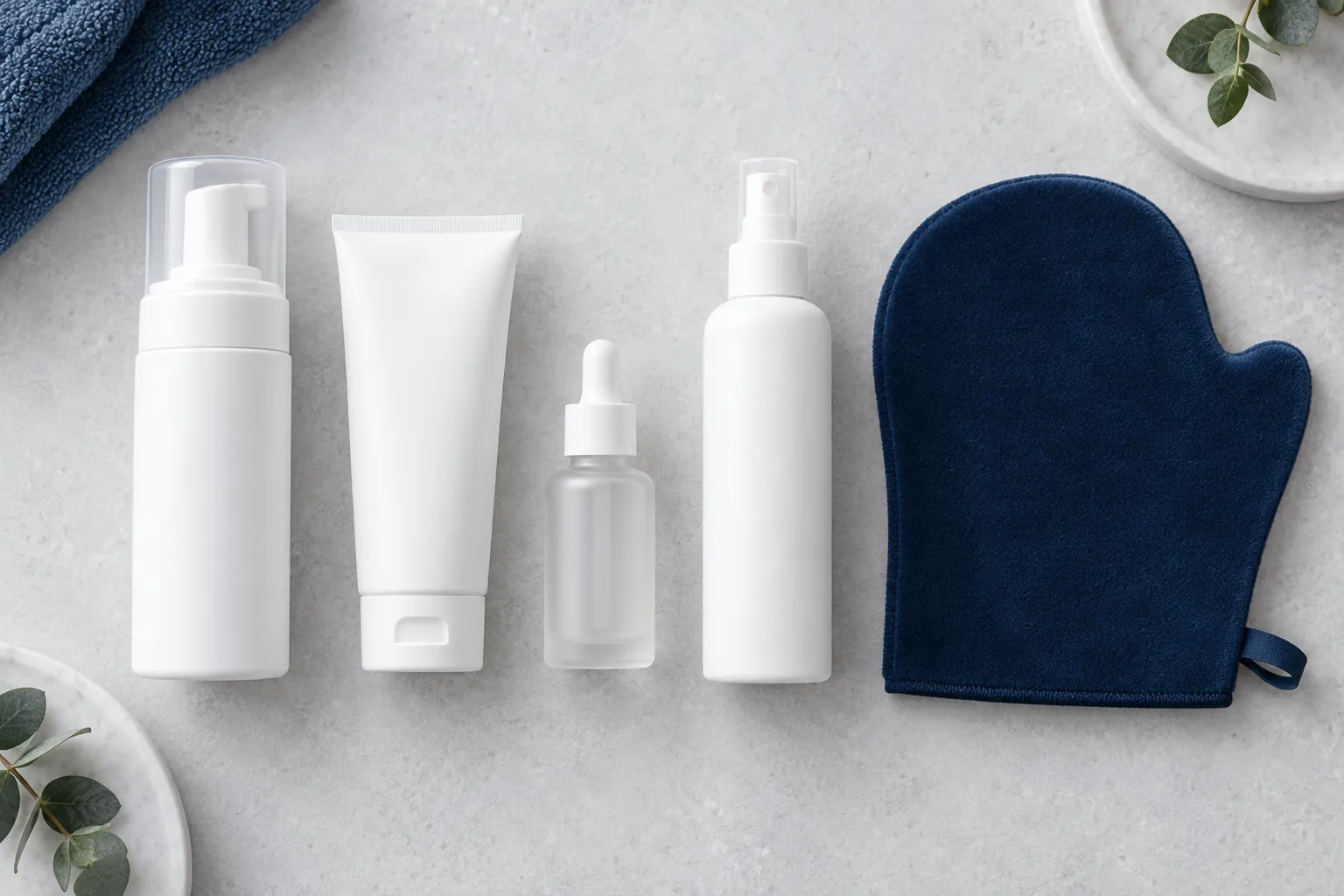
Self-tanners come in five main at-home formats, shown below. Tell us the format and pack, and we confirm fit with your quote. Aerosol sprays and tanners with SPF are outside this page: a sunscreen is an over-the-counter drug in the US and has to be made, tested and labeled as one.
| Format | Used for | Typical pack | Watch for |
|---|---|---|---|
| Tanning mousse | One-coat tan applied with a mitt | Non-aerosol foaming pump | Needs a guide color to show streaks |
| Gradual tan lotion | Daily moisturizer that builds color | Tube or pump | Lower DHA; yellows in clear packs |
| Face tanning drops | Mixed into a moisturizer | Glass dropper | Face color fades sooner |
| Tanning gel or serum | Fast-drying tan | Pump or tube | Thin films can streak |
| Water-based tanning mist | Top-up for body or face | Non-aerosol mist sprayer | Keep away from eyes, lips and nose |
| Salon spray-tan solution | Airbrush or booth use | Bulk bottle | Not approved by FDA for booths; see above |
How does a self-tanner project work at Moe’s Group?
It runs in five steps, from brief to filled and labelled product, all at our facility in Chatsworth, California.
- Send your brief. Tell us the format, shade, claims and volume through the Request for Quote form.
- Review the raw-material documents. Ask for the DHA spec sheet and certificate of analysis with your quote; FDA’s specification calls for at least 98% DHA, with limits on lead, arsenic and iron (21 CFR 73.1150).
- Formulation and shade. Our in-house chemists develop the formula and guide color with you.
- Stability and claims. Stability testing in your chosen pack comes before launch, and claims are settled using the table above.
- Production. Filling and labelling run in house in Chatsworth. The minimum order is custom private label from 1,000 units; white label from 200 units where a ready formula exists.

Can Moe’s Group make private label self-tanner, and what is the MOQ?
Yes: Moe’s Group formulates, fills and labels private label self-tanner in Chatsworth, California: custom private label from 1,000 units; white label from 200 units where a ready formula exists. Private label means a formula developed for your brand; white label means an existing formula under your label, with less room to change the shade. Lead time depends on the formula and is set out in your quote. The facility has capacity for up to 1,000,000 units a month across skin, hair and body care. For other body formats, see our private label body care manufacturing page; for packaging choices, our cosmetic packaging page.
Frequently asked questions
What percentage of DHA should a self-tanner have?
Most marketed self-tanners use 3% to 5% DHA. Gradual lotions sit lower and express or dark formulas higher, depending on the shade and the customer’s skin tone.
Does a self-tanner need a sunscreen warning?
Yes, if it contains no sunscreen. 21 CFR 740.19 requires tanning products without a sunscreen, including DHA self-tanners, to warn that the product does not contain a sunscreen and does not protect against sunburn, and that repeated unprotected sun exposure may increase the risk of skin aging and skin cancer.
Can a self-tanner contain SPF?
Only if it is made, tested and labeled as an over-the-counter sunscreen drug. The self-tanners on this page contain no SPF, and a DHA tan is not a sunscreen and gives no meaningful UV protection.
Why do some self-tanners turn orange or smell?
Both come from DHA’s browning reaction. Too much DHA for the skin tone reads orange, and the reaction leaves a scent. Shade work and fragrance reduce both.
Can a self-tanner be made without DHA?
A wash-off bronzer can, using listed color additives such as caramel or iron oxides, but it lasts until the next wash. Erythrulose is not a listed US color additive, so get regulatory advice first.
How long does a sunless tan last?
Usually 5 to 7 days. The color sits in the outermost layer of dead skin cells and fades as they shed, faster on the face.
Does a self-tanner have to be approved by the FDA?
No. Self-tanners are cosmetics, which the FDA does not approve before sale. DHA is a color additive listed at 21 CFR 73.2150 for external use, and the brand is responsible for safety and labeling.
What is the minimum order for a private label self-tanner?
At Moe’s Group the minimum order is custom private label from 1,000 units; white label from 200 units where a ready formula exists. Lead time depends on the formula and is set out in your quote.
Related pages
- Private label body care manufacturing
- Private label body scrub and body polish manufacturing
- Private label body oil and body glaze manufacturing
- Private label women’s body care manufacturing
- Private label body lotion manufacturing
- Private label body products: cosmetic or drug?
- Private label cosmetics: who files with the FDA?
- Cosmetic packaging
- Our California skincare manufacturing facility
- Certifications and FDA facility registration
Sources
- 21 CFR 73.2150 and 73.1150 (dihydroxyacetone), 73.2085, 73.2250 and 73.2496 (caramel, iron oxides, mica) and 70.3(v) (externally applied), eCFR, read October 28, 2026
- 21 CFR 740.19, Suntanning preparations
- U.S. Food and Drug Administration, “Sunless Tanners and Bronzers” (content current as of October 15, 2024)
- U.S. Food and Drug Administration, “Is It a Cosmetic, a Drug, or Both? (Or Is It Soap?)”
- 21 U.S.C. 364h, Small businesses (Modernization of Cosmetics Regulation Act of 2022)
- Federal Trade Commission, “Health Products Compliance Guidance” (December 2022)
- Braunberger, Nahhas, Katz, Sadrieh and Lim, “Dihydroxyacetone: A Review,” Journal of Drugs in Dermatology 17(4):387-391 (2018)
- eCFR full-text search of Title 21 for erythrulose, October 28, 2026: 0 results
- U.S. Patent 6,231,837, Self-tanning dihydroxyacetone formulations having improved stability and providing enhanced delivery (optimum DHA stability at about pH 4.0)
- MakingCosmetics, Dihydroxyacetone Specification Sheet (updated May 21, 2024): final product pH 3.5 to 5
Start a self-tanner product
Tell us the format, shade and claims you have in mind, and our chemists will come back with options and a quote. Prefer to talk it through first? Book a free consultation.